
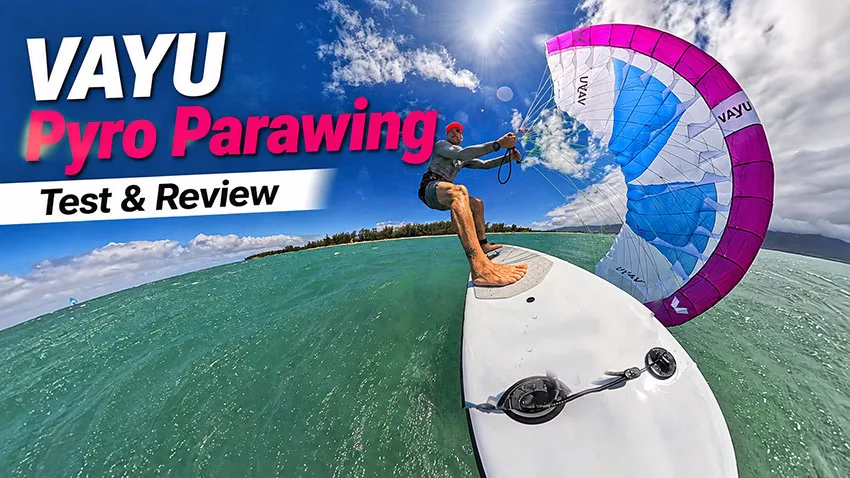
Tested in Maui Winds up to 32 Knots
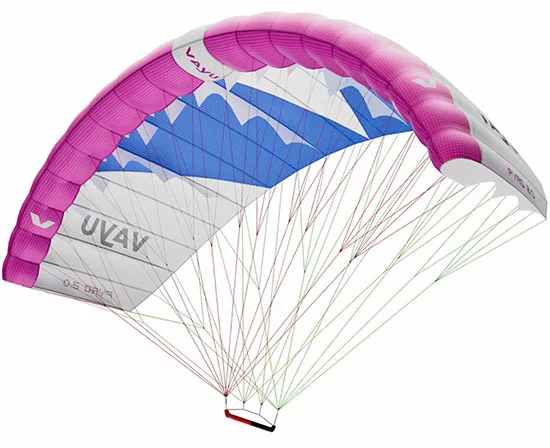
Parawings are quickly becoming one of the biggest trends in foiling, combining the ability to get upwind under power with the freedom to stash the wing and ride swell hands-free. With the PYRO, VAYU has now entered the growing parawing market with a compact single-skin design aimed at experienced foilers and wingfoilers.
We had the opportunity to test the VAYU PYRO 3.2m on Maui, and Maui being Maui, we didn’t exactly get laboratory conditions. Our test included everything from relatively friendly 22–24 knot trade winds to gusts reaching around 32 knots.
Considering VAYU lists the official wind range of the 3.2m PYRO at 18–28 knots, we certainly got to find out what happens when you push the parawing beyond its intended upper limit.
VAYU designed the PYRO around a simple concept: create an ultra-light parawing that is easy to fly upwind, quick to stash and easy to redeploy.
The PYRO uses a compact single-skin canopy combined with relatively short bridles and VAYU’s new Bridge Bar control system. According to VAYU, the goal was to create handling that feels direct, calm and predictable, particularly for riders coming from wingfoiling.
The PYRO has been developed and tested in demanding foiling locations including the Columbia River Gorge, Fuerteventura and Hawaii.
Available sizes are 2.5m, 3.2m, 4.0m and 5.0m, with the 3.2 sitting right in the middle of the range.
VAYU PYRO Wind Ranges
- 2.5m: 25+ knots
- 3.2m: 18–28 knots
- 4.0m: 15–25 knots
- 5.0m: 12–18 knots
For Maui trade winds, the 3.2m looked like a particularly interesting size, so that is the version we put to the test.
First Impression: A Very Nice Backpack
Before even getting to the Parawing itself, there is one detail worth mentioning: The backpack.
A small backpack is included with the PYRO, and we were pleasantly surprised by it. This isn’t just a throwaway stuff sack designed to keep the product together until you get home.
It is compact, nicely finished and feels like something you will actually use.
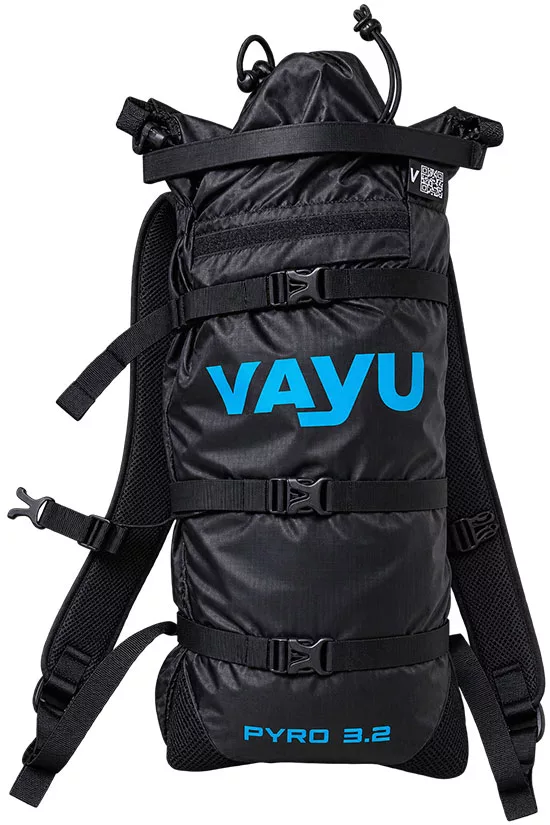
That might sound like a small detail, but Parawinging is all about reducing the amount of equipment you have to deal with. Having the complete Parawing packed into a small, good-quality backpack fits that philosophy perfectly. The backpack also ads a tremendous value to the purchase of a not very cheap product.
The Bridge Bar
One of the most distinctive features of the PYRO is VAYU’s Bridge Bar.
Rather than simply attaching the flying lines to a conventional bar setup, VAYU uses what it calls a bridge-line architecture. Each rib group has its own leader line, allowing the load on the canopy to increase progressively as the rider sheets in.
The center section is also kept clear, which means virtually the entire bar can be used as a grip area. You can move your hands along the bar without running into hardware in the middle.
The curved bar ends provide another useful reference point for your hands while also helping reduce the chance of lines wrapping around the ends.
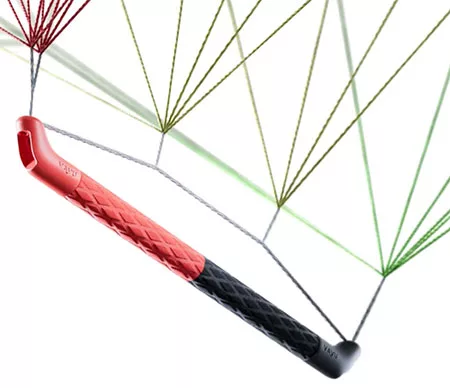
Bar length changes according to PYRO size. The 3.2m uses a compact 315mm bar, which helps when it comes time to stash everything on the foil.
Short Lines and Less Clutter
Anyone who has experimented with parawings knows that lines can quickly become one of the more intimidating parts of the system.
VAYU has clearly put some thought into keeping things manageable.
The PYRO uses short center bridles of approximately 1.3 to 1.5 meters, depending on size. The 3.2 uses 1,370mm lines. The shorter system is designed to make killing the power, pulling in the canopy, stashing and relaunching easier.
The lines are also color coded, which makes sorting out the parawing much easier when unpacking.
The A/B/C/D layout with brake risers may look complicated when you first inspect it, but in actual use the system is quite clean. That becomes important when you’re standing on a foil board with wind blowing and don’t want to spend your session untangling lines.
Maui Test #1: Let’s See What Happens at 32 Knots
Our first serious Maui test ended up being considerably more extreme than planned. The wind was blowing hard, with gusts reaching approximately 32 knots.
For perspective, VAYU gives the PYRO 3.2 an upper recommended wind range of 28 knots. We were therefore testing the Parawing several knots beyond the manufacturer’s stated range.
And the interesting part was that the PYRO could actually handle it.
The canopy remained manageable and the parawing itself did not suddenly become unstable simply because we had crossed the 28-knot mark.
But there is a big difference between something being able to fly in that much wind and actually being enjoyable or useful to ride.
At 30+ knots, there was simply too much power to maneuver the 3.2 in a meaningful way. Everything happens faster, the loads increase and managing the parawing becomes the dominant part of the experience.
In other words, we found the limit — and it confirmed why VAYU specifies 28 knots as the top end of the 3.2’s intended range. For those conditions, the smaller 2.5m PYRO would clearly be the more appropriate choice.
VAYU PYRO 3.2 Video Review – Chapters
0:00 – Intro
0:29 – The Backpack
1:44 – The Handlebar
2:44 – The Lines / The Canopy
4:04 – Quick Test Behind the House
4:51 – In Kanaha
5:35 – Crazy Winds
6:55 – Normal Winds
8:13 – Other Features
Watch our complete VAYU PYRO 3.2 Parawing test on Maui to see the equipment in detail and, more importantly, how it performed when the Maui trade winds turned from friendly to crazy.
Maui Test #2: 22–24 Knots Changes Everything
Our next session gave us much friendlier Maui trade winds of approximately 22–24 knots.
And this is where the PYRO 3.2 really started to make sense.
In these conditions, the 3.2 flew excellent.
Instead of simply trying to manage excess power, we could actually concentrate on flying the Parawing, controlling the foil and getting a better feeling for the characteristics of the PYRO.
The power delivery felt controlled and predictable, and the compact bar makes it easy to make relatively small adjustments.
This was much closer to what VAYU describes as the intended character of the PYRO: a parawing that feels calm and direct rather than nervous.
VAYU itself points out that parawinging works best in consistent, steady wind, while very gusty conditions make the experience considerably more demanding. Our Maui testing certainly confirmed that statement.
Stash It and Ride
Of course, the big attraction of a parawing isn’t simply riding around while holding it.
The whole point is what happens next.
Use the parawing to generate enough power to get onto foil and work your way upwind. Once you’re in position, depower it, pull it in, stash it and use the energy of the ocean to foil downwind with nothing in your hands.
This is where the PYRO’s short lines, compact bar and lightweight canopy become particularly relevant.
Everything has been designed around reducing the amount of equipment you have to manage when transitioning from powered riding to free foiling.
And that is ultimately what makes the current parawing movement so interesting. It is not simply another alternative to a conventional wing. It opens up a different style of foiling altogether.
Our Verdict on the VAYU PYRO 3.2
Our Maui sessions gave the PYRO a pretty serious introduction.
At gusts around 32 knots, the 3.2 demonstrated that it could cope with conditions beyond its official 18–28 knot range. But just because something is possible doesn’t mean it makes sense. At that point there was simply too much power to maneuver the Parawing effectively.
Move back into the 22–24 knot range, however, and we had a completely different experience.
Here the VAYU PYRO 3.2 flew extremely well, with predictable power and a clean, direct feeling through the Bridge Bar.
We also like some of the less glamorous details: the short and well-organized bridle system, compact bar and especially the surprisingly nice little backpack included with the parawing.
The PYRO feels like a product designed around what parawing riders actually want: less equipment, less clutter and an easier transition from powered foiling to riding swell hands-free.
And after testing the 3.2 in everything from normal Maui trades to conditions where we probably should have been on the 2.5, we can say one thing with certainty:
The PYRO 3.2 has a pretty impressive usable range — but around 22–24 knots was where we had the most fun.