
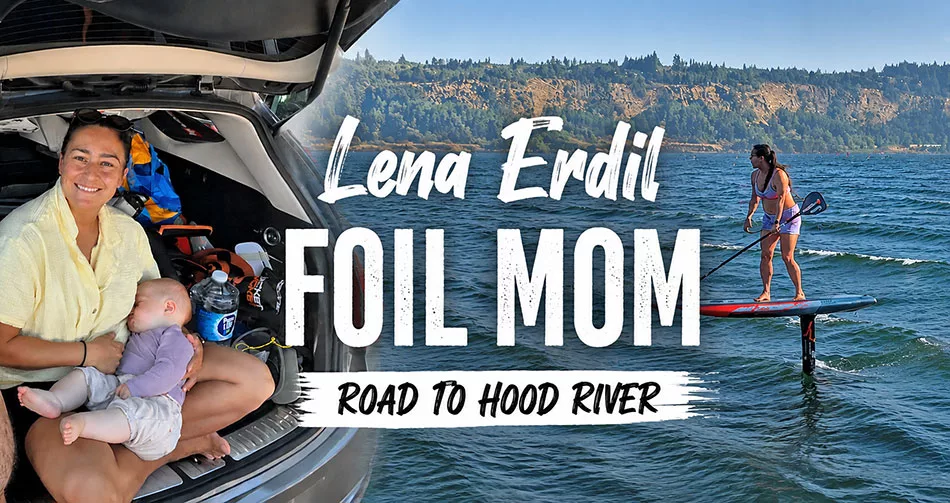
From Professional Windsurfer to “Foil Mom”—Her Road to Hood River
For many years, Lena Erdil was among the world’s top windsurfers. Today, she’s found a new challenge: downwind foiling. After the birth of her daughter Ella, Lena worked her way back onto the water step by step—with a clear goal in mind: to spend several weeks in Hood River and take her foiling skills to the next level there. We spoke with Lena about her “Road to Hood River,” flatwater paddle-ups, parawings, smaller foils, and everyday life as a “foiling mom.”
Stand Up Magazin: Lena, you have a background in professional windsurfing. What is it about downwind foiling that really got you hooked?
When you’ve been windsurfing professionally for years, you’re used to knowing exactly what you’re doing out on the water. With downwind SUP foiling, it was suddenly a whole different story for me. I was a beginner again—and that’s exactly what hooked me.
The sport wasn’t entirely new to me, though. Before I got pregnant, I’d already gone on SUP downwind trips. Then pregnancy and childbirth led to a long break. When I started again, I found myself wondering: How do I get back into it—and just how fit am I, really?
That’s how my personal “Road to Hood River” came about: getting back in shape for downwind riding step by step, so I could then spend several weeks in the Columbia River Gorge improving my foil skills.
What began as a personal challenge ultimately turned into a journey into a foil scene that’s probably a few years ahead of us here in Europe.
What’s the downwind foiling scene like where you are in northern Germany?
Here, downwind foiling is still a small but rapidly growing scene. Around Kiel and along the Baltic Sea, more and more people are getting into it—many of them, like me, come from other water sports such as windsurfing, wing foiling, or SUP.
Actually, we have good conditions: plenty of wind and a variety of routes depending on the wind direction.
The conditions are different here than in Hood River, though. The Baltic Sea doesn’t have those steep river bumps, but we do have days with groundswell and wind-generated waves. You have to learn to choose the right spot—and, of course, the right gear—for each wind direction.
On social media, it sometimes seems as though you have to master the flatwater paddle-up first. Is that really a prerequisite?
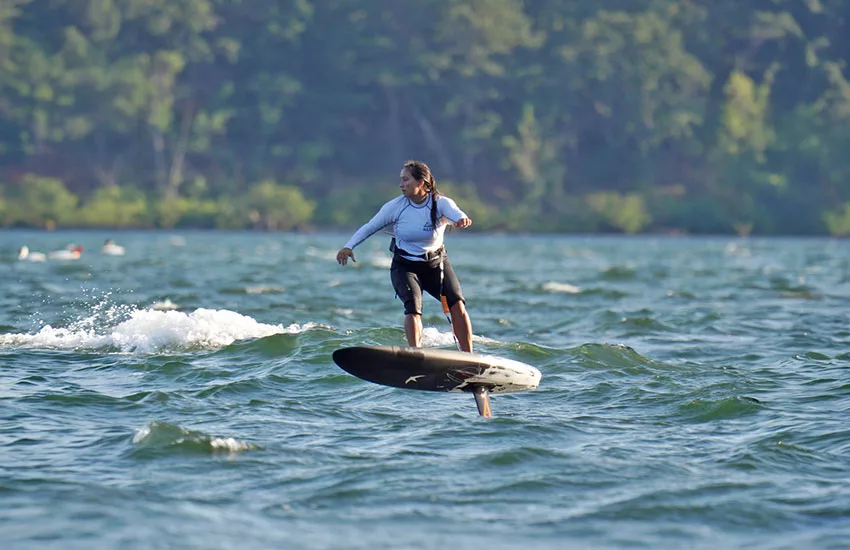
No. That’s something that’s important to me.
Social media can easily give the impression that you have to master a Flatwater Paddle-Up before you can even try SUP downwind foiling. That’s not true.
I myself had been paddling downwind even before my pregnancy, without ever having done a flatwater paddle-up. Wind and waves help tremendously with the start. Often, starting with a bump is even easier than in completely flat water.
For me, the paddle-up had a different significance: It was my personal fitness test.
My challenge was this: If I can paddle a downwind board onto the foil in completely flat water using only my own strength, I’ll know that my body is strong enough again.
Plus, small winter sessions at the dock were much easier logistically than organizing big downwinders on the Baltic Sea right away.
In May, I finally managed my first paddle-up, followed shortly afterward by three more—and before I knew it, I was back out with the real downwinders.
So if you want to learn downwind foiling, you definitely shouldn’t think, “I can’t do that until I can do a flatwater paddle-up.”
You were a professional windsurfer for years and even competed in the Olympics in the iQFOiL. Today, you call yourself a “Foil Mom.” How has your athletic life changed?
Very much so! Our daughter Ella was born in late 2025. My partner Kai is also completely obsessed with foiling, and our daily life now often involves juggling the baby, the stroller, the foils, and the wind. We call it our “Foiling Parents Mode.”
Sometimes one of us goes on a downwinder and the other picks them up at the bottom with Ella. In Hood River, we even strapped my downwind board to the stroller and pushed it to the starting point.
We just can’t spend five hours together like we used to. So now we take turns: one of us goes out on the water, and the other stays with Ella.
But that actually motivated me more rather than less. Getting back into shape after giving birth while also making progress in a new sport gave me a new athletic goal.
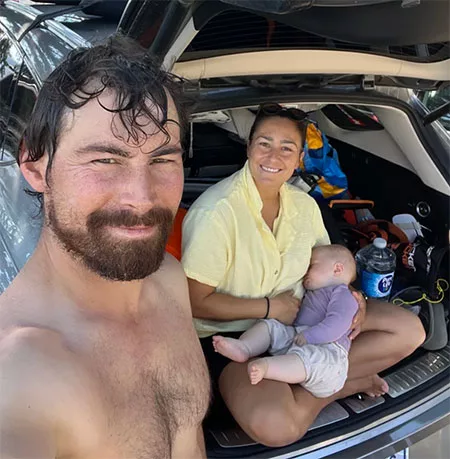
A dream vacation in Hood River with the whole family. We at Stand Up Magazine are sure that little Ella will grow up to be a great water sports enthusiast, just like her mom and dad.
Then we headed to Hood River. What were your expectations for the trip?
Above all, time on the water.
Hood River—or rather, the Columbia River Gorge—is considered one of the hubs of the international foil scene. The Columbia River flows westward, and in the summer, strong westerly winds often blow against it. This creates those famous steep bumps.
We had planned to stay for three weeks and were staying in White Salmon.
Above all, I wanted to spend many hours on the water there, without the constant organizational hassle we have at home.
In the end, there were so many windy days in a row that Kai and I would check the conditions in the morning, and neither of us wanted to be the first one out on the water. After six straight days of wind, we suddenly found ourselves saying, “No, no, you go ahead. I’ll watch Ella.”
You came to Hood River with the idea of doing classic downwind shuttles. But once you got there, you realized that a lot of people were riding Parawings.
I had actually imagined it the traditional way: getting dropped off at the top, sailing downwind for several kilometers, and then being picked up again at the bottom.
Once I got there, I quickly realized that the area around Hatchery isn’t always the most practical option. The well-known entry points, Tunnel 4 and Tunnel 5, are logistically inconvenient—there are hardly any parking spots, and some of the area is private property. Plus, the really good, steep bump section isn’t endless.
That’s when I realized why so many people in Hood River are now paragliding.
Instead of organizing a shuttle for a relatively short run, you can use the Parawing to ride back upwind at the Hatchery, stow the wing, and foil downwind through the bump section again. Then you start all over again.
That way, you can cover a lot of kilometers and do a lot of repetitions without constantly driving back and forth.
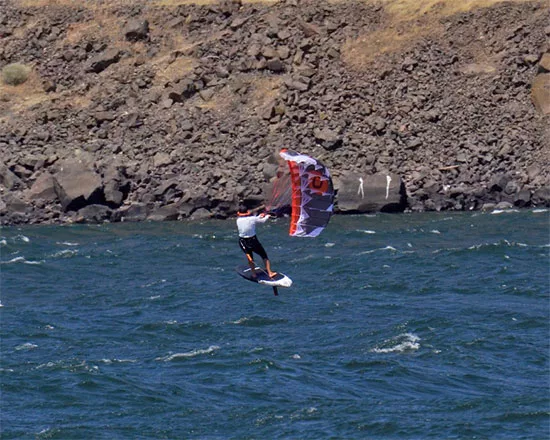
The Parawing as a means to an end: That’s how the Parawing was invented two years ago on Maui by Greg Drexler. Development is advancing rapidly in the sport and in the creation of new materials. The Parawing has long since become more than just a “tool” for downwinders, and more and more “inland foilers” are switching from the wing to the Parawing.
In downwind spots like Hood or Maui, you see more parawings than wings.
And how well did the Parawing work for you?
To be honest, I had been putting off working on this topic before the trip and had only done two sessions in Kiel beforehand.
In Hood River, the Parawing turned out to be the perfect complement to paddling. It’s not easy, though. Especially in gusty winds, a relaxed session can quickly turn into a lot of swimming.
On longer runs, though, I’ve also seen its limitations. The Columbia River can be extremely windy and yet suddenly have a complete lull. When the wind dies down, even the best parawing won’t help you anymore. That’s exactly when a paddle is worth its weight in gold.
That’s why I no longer see the paddle and the parawing as competitors, but rather as two different tools: the parawing for short, repeated runs, and the paddle for safety and, above all, for longer distances.
What was your experience with the foil community in Hood River?
Foiling is completely normal there.
At the Hatchery, there are cars full of downwind boards, foils and parawings are everywhere, and people are talking about runs, foil sizes, and setups. There are a lot of really good riders out there.
You learn an incredible amount just by watching, and it also helps you strike up a conversation very quickly.
In Hood River, your foil distances kept getting shorter and shorter: 1,300, 980, 850, and finally even 720. What did you learn from that?
Up until then, I had mainly been riding a 1300 Frontwing at home.
On my first day in Hood River, I was able to paddle a 980 right away. That motivated me—maybe a little too much. I thought: If I can do a 980, then an 850 should be possible, too.
That’s when I quickly realized my limits. I was able to paddle the 980 up, but with the 850, the paddle didn’t work reliably yet.
With the Parawing, it was a completely different story. As soon as the Parawing takes over the acceleration during takeoff, you need much less foil surface area. And once you’re flying, you realize just how much lift even a small foil can still generate.
Later on, I even did a 720.
That was the real “aha” moment for me: My limit wasn’t riding the small foil. My limit was getting it to fly in the first place with the paddle.
Does that mean: The smaller the foil, the better?
No, not at all.
Hood River isn’t always a spot for the “smallest foil,” either. Depending on wind speed and wind angle, you’ll need to adjust the foil size.
One day, I deliberately went back to my 1130 because I wanted to focus on downwind sailing rather than testing its power during takeoff.
For me, the interesting question hasn’t been “How small can I go?” ever since, but rather: How small can I go in a way that makes sense given the available energy?
I’m now confident riding with larger foils. So my next step is not just to ask if I can do a downwinder, but also if I can do it with a smaller foil.
A large foil is very forgiving. With a smaller foil, I have to ride more efficiently, choose better lines, and make more consistent use of the energy from the bumps.
Do you really have to travel to Hood River for conditions like that, or can you also learn downwind foiling on the Baltic Sea?
You definitely don’t have to fly to Hood River to learn downwind foiling.
The trip made me realize once again that we have a really great downwind sailing area right here at home around Kiel. Whether the wind is blowing from the west or the east, there are different routes to sail, and many of them are easy to shuttle to.
I find the westerly wind in Eckernförde Bay especially good for learning. The bumps are small and steep, and they give you a nice boost for takeoff.
Generally speaking, stronger winds make it easier to get started. At around 25 knots, the bumps become more exciting and provide significantly more energy—though this always depends on your experience, safety, and the route, of course.
So it’s possible to learn the basics and make a lot of progress right in your own backyard.
What would you recommend to someone who wants to start SUP downwind foiling now?
Don’t make things unnecessarily hard for yourselves at the beginning.
Above all, don’t wait until you reach the supposedly “perfect” skill level before trying downwind. As I said, the flatwater paddle-up isn’t a prerequisite.
What really helps is going out on the water with someone who knows the area and can help you set up your gear.
The board, foil size, and technique must be suited to the individual. A foil that works perfectly for an experienced rider can make the learning process unnecessarily difficult for a beginner.
I had one big advantage: Kai.
When I was learning to paddle up, he was often on the shore with Ella anyway, so he was able to watch my countless attempts and give me immediate feedback. Especially when it comes to small technical details—acceleration, paddle technique, or the right moment to get the foil off the water—that makes a huge difference.
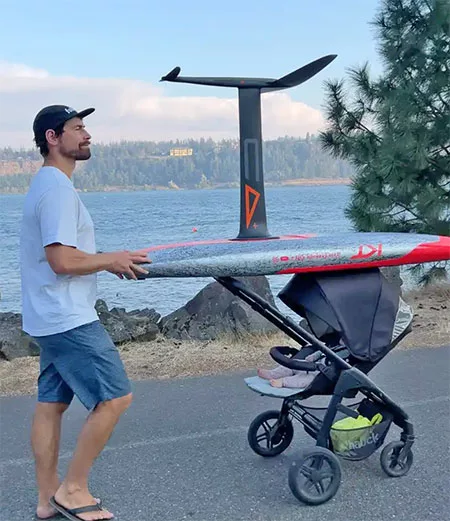
Foil Papa Kai Steimer acts as a board caddy with the stroller. Kai is a veteran of the German SUP scene with countless titles to his name and now runs foilit.de and imports various foil and SUP brands.
If you’d like to get started here in the north, you can contact Kai directly through Foilit.de. He can advise you on choosing equipment and offers paddle and foil coaching. Good coaching can save you a lot of frustrating sessions and wasted purchases, especially when you’re just starting out.
What kind of gear are you currently using?
I’m now riding Code Foils, and I recently joined the Code Foils team.
Given the conditions at home, a 1300 front wing remains my most effective downwind setup. It launches early, carries me through lighter sections well, and gives me the leeway to focus on reading and linking the bumps.
But Hood River showed me that I don’t want to rely on that extra surface area in the long run. The 980 was the first step; with the Parawing, I went all the way up to the 720.
When it comes to boards, I prefer a long, narrow downwind board that accelerates quickly and makes it easier to paddle up.
With the Parawing, I also tried out some completely different setups in Hood River—including a 44-liter sinker. As long as there was enough wind, even that worked.
It’s exactly this range that I find exciting: not searching for the one perfect foil, but understanding which setup works best for each day.
What do you take away from your “Road to Hood River” in the end?
I didn’t go to Hood River to learn how to do my first downwind runs there. My goal was to get back into the sport in earnest after my pregnancy and childbirth.
That’s exactly what happened—and even more.
I added the Parawing to my setup, which allowed me to try out smaller foils and understand just how much more speed and freedom these setups offer when riding bumps.
I want to learn how to use less foil. Not to show off with smaller numbers on paper, but because it means making better use of the energy in the water.
Whether I’ll be able to do that on the Baltic Sea is my next question.
After many years of professional sports, I’ve found a sport again where I constantly face new challenges—except that these days, my training usually involves fitting a baby, a stroller, a paddle, and a parawing into the car.
Do you like our content and want to see more stories like this? A lot of hard work and enthusiasm goes into it, and we need your support.

Online Subscription
Are you enjoying the content of the Stand Up Magazin?
With a subscription, you help secure the future of Stand Up Magazin.
Become a patron and supporter with your subscription.
Your subscription is an annual contribution and renews automatically.