
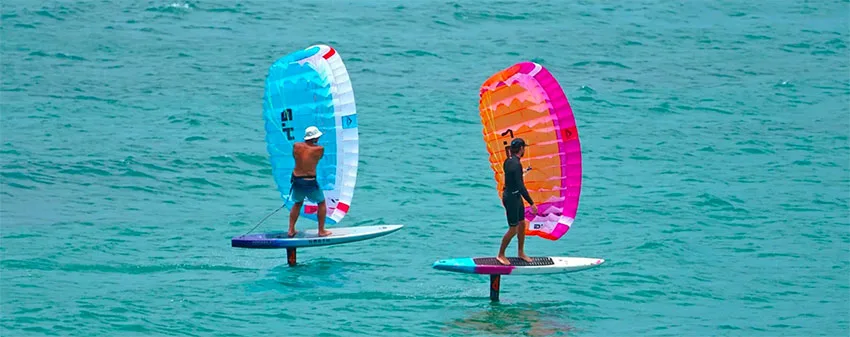
Flow D-Wing V2 Review: Parawing Test in Gusty Maui Conditions
The parawing market continues to move fast, and Flow Paragliders is back with the second generation of its D-Wing. The new Flow D-Wing V2 promises more stability, a significantly wider wind range and, above all, improved upwind performance.
We had the chance to take the new D-Wing V2 out at Kanaha on Maui – although our test conditions were anything but consistent.
During the session, the wind was all over the place, varying from roughly 12 knots to gusts approaching 30 knots. That made the test somewhat special: instead of enjoying perfectly steady trade winds, we got to experience the D-Wing V2 across a huge range of conditions in a single session.
Sometimes we were searching for enough power to get going, while only a short time later we had to deal with considerably more wind. Not necessarily the conditions you would choose for a relaxed test session, but certainly an interesting way to find out how much usable range a modern parawing can offer.
Rather than giving everything away here, watch our vlog-style test video from Kanaha and see how the Flow D-Wing V2 handled Maui’s highly variable conditions.
What Is New on the Flow D-Wing V2?
Flow describes the D-Wing V2 as a major evolution rather than a small update of the original D-Wing. The main focus for the second generation has been on stability, control, usable wind range and upwind performance.
Central to the design is Flow’s reflex airfoil, which is intended to keep the canopy stable even when the wing is heavily depowered.
According to Flow, this allows riders to point high upwind across a broad range of wind strengths – from marginal conditions where getting onto foil is the main challenge all the way to heavily powered and gusty sessions.
One particularly interesting feature is the ability to fly the D-Wing V2 on the A-lines only when depowered. This allows the rider to dump a substantial amount of power while keeping the canopy stable and continuing to make progress upwind.
For parawing riders who want to use the wing as a tool to get upwind before stowing it and riding swell back downwind, that is obviously an important characteristic.
Wider Wind Range and More Stability
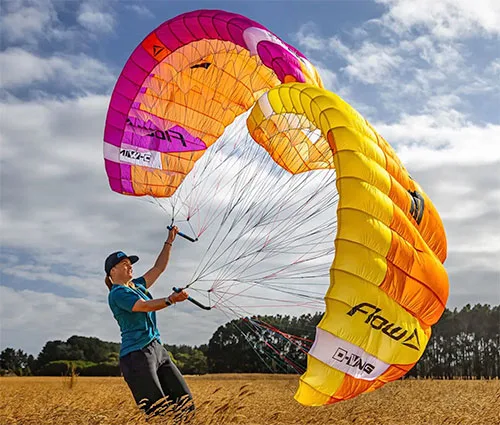
A larger usable wind range is one of Flow’s main claims for the V2.
At the lower end, the wing has been designed to generate enough power for earlier takeoffs and getting up onto foil. At the opposite end of the spectrum, Flow says the V2 offers substantially improved control when overpowered.
This wider range should make the wing easier to handle when conditions aren’t perfectly consistent – something we certainly had plenty of during our Kanaha session.
The ability to depower the wing while maintaining its shape also becomes particularly relevant when working upwind. Flow says riders can completely depower the D-Wing V2 and fly it using only the front lines, reducing excess power without sacrificing the ability to hold an efficient upwind course.
More Playful Handling
Performance isn’t only about getting upwind. Flow has also worked on making the D-Wing V2 easier and more intuitive once you’re actually riding.
Turning and jibing are said to be smoother and more predictable compared with the original D-Wing. According to Flow, feedback from riders testing the V2 has also shown fewer falls during transitions.
That might sound like a relatively small detail, but with parawings, predictable canopy behavior can make a big difference. Less time dealing with an unstable wing means more time concentrating on the foil, your line and the swell.
New Full-Carbon Bar
Another significant change is the redesigned full-carbon control bar.
The D-Wing V2 now uses a floating B-line attachment point that allows the rider’s back hand to move freely along the bar. The idea is to create a more natural hand position while giving the rider greater freedom to adjust grip depending on how powered the wing is.
Flow says this improves ergonomics and overall control, particularly when riding powered or trying to maximize upwind angles.
Shorter Lines for Easier Stowing

Stowing a parawing quickly and cleanly remains one of the key aspects of the entire concept, and Flow has made several changes here as well.
The D-Wing V2 uses shorter lines of approximately arm length, reducing the amount of line that needs to be managed when packing the canopy away.
The A-lines are also split and easily identifiable, helping the rider recognize the front lines immediately during stowing and redeployment.
The canopy, lines and bar remain color-coded, with the goal of reducing tangles and making the entire stow-and-relaunch process faster and more intuitive.
For downwind foiling, where riders may deploy and stow their parawing multiple times during a session, these seemingly small details can become very important.
Smaller Pack Size with 32-Gram Ripstop
Flow has also addressed packability.
The D-Wing V2 uses a new premium 32-gram ripstop fabric that is designed to combine durability with a considerably smaller packed volume.
A compact package is particularly valuable for downwind riding. Once the wing has done its job getting you onto foil or taking you upwind, you don’t want a large bundle getting in the way while riding swell.
Flow says premium materials are used throughout the D-Wing V2, including the canopy, lines and carbon bar, with the aim of finding a practical balance between low weight and durability.
Flow D-Wing V2: A Parawing Focused on Range and Upwind Performance
The second-generation D-Wing shows just how quickly parawing equipment is developing.
Where the first generation of parawings was largely about proving that the concept worked, newer designs are increasingly focusing on the details: better depower, wider wind range, more efficient upwind angles, easier transitions and faster stowing.
Those are exactly the areas Flow has targeted with the D-Wing V2.
Our test at Kanaha also gave us an unusually broad range of wind conditions to play with. With the wind fluctuating between approximately 12 and 30 knots, we certainly didn’t get the perfectly steady Maui trade-wind session we might have wished for.
But maybe that’s not such a bad thing when you’re testing a wing whose biggest selling points are supposed to be range and stability.
Check out our full Flow D-Wing V2 vlog and review from Kanaha to see how the new parawing performed on the water.
Flow D-Wing V2 – Key Features
- Reflex airfoil design for increased canopy stability
- Improved upwind performance
- Wider usable wind range
- Strong low-end performance for getting onto foil
- Improved control when overpowered
- Ability to depower and fly using the A-lines
- Smoother turning and jibing
- New full-carbon bar
- Floating B-line attachment point
- Shorter, approximately arm-length lines
- Split A-lines for easier identification
- Color-coded canopy, lines and bar
- New 32-gram premium ripstop fabric
- Reduced packed volume
This article was possible thanks to the support of Flow Paragliders in Australia. Thank you very much. Are you interested in more content like this? Please support our youtube channel and become a patron of our work.

Online Subscription
Are you enjoying the content of the Stand Up Magazin?
With a subscription, you help secure the future of Stand Up Magazin.
Become a patron and supporter with your subscription.
Your subscription is an annual contribution and renews automatically.