

Starboard introduces the new Flux SUP paddle, combining elements of the popular Enduro with ideas taken from the race-oriented Velocity. The result is an interesting new paddle concept designed around higher cadence, reduced fatigue and a smoother stroke.
For years, SUP paddle development at the performance end of the market has largely been about maximizing power transfer and efficiency. With the new Starboard Flux, the focus shifts slightly. Instead of asking how much power can be generated with every stroke, Starboard is asking how efficiently a paddler can keep going.
The idea is summed up by Starboard rather simply: “Less force. More flow.”
The Flux combines characteristics of two established paddles in the Starboard range. The stability and versatility come from the Enduro side, while the smoother, more efficient stroke takes inspiration from the Velocity race paddle.
That combination makes the Flux particularly interesting because Starboard isn’t positioning it strictly as a racing paddle. It is designed for SUP surfing, touring and general paddling, with an emphasis on maintaining a relatively high cadence without unnecessarily loading the shoulders and muscles.
Foiling Technology finds its way into a SUP paddle
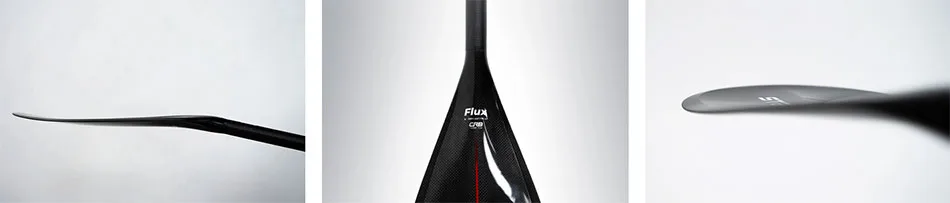
One of the most noticeable features of the Flux blade is its small winglets.
Starboard says the idea came from its development work in foiling. The winglets run along the sides of the blade and are designed to control water flow and reduce turbulence around the blade.
In practical terms, the goal is less flutter and a more stable feeling while pulling the paddle through the water.
It’s an interesting example of how technology developed through the rapidly evolving foil segment is now finding its way back into traditional SUP equipment.
Double concave for stability through the stroke
The Flux also uses a double-concave blade shape.
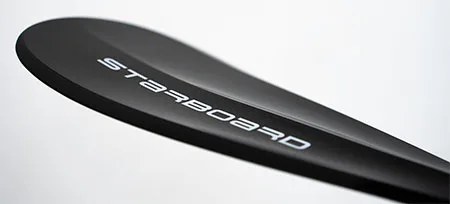
According to Starboard, this distributes pressure more evenly across the blade while helping it track through the water. The design is intended to produce consistent power from the catch through the main power phase while reducing unwanted movement and splash.
Combined with the winglets, the concept isn’t necessarily about creating a more powerful blade. It’s about making the power easier to control.
That distinction is important.
A paddle that produces a huge amount of resistance can feel impressive for a few strokes, but over a long session that additional load can become tiring. The Flux takes almost the opposite approach: keep the blade stable and efficient enough that the paddler can increase cadence without having to muscle every stroke.
A clean catch with a 13-degree blade angle
Starboard has given the Flux a thin, flat blade tip designed for a particularly clean entry and exit.
The blade is set at a 13-degree angle, putting the Flux firmly into all-round territory. Starboard says this provides enough immediate acceleration for SUP surfing while remaining comfortable and efficient for flat-water paddling.
For surfers, that could be particularly useful when several quick strokes are needed to accelerate onto a wave.
For recreational and touring paddlers, the same characteristics should allow the paddle to generate useful power without demanding particularly refined race-paddling technique.
The wide teardrop-shaped lower blade also provides a substantial catch, something Starboard says makes the Flux accessible to less experienced paddlers.
The real story is fatigue
Perhaps the most interesting aspect of the Flux isn’t any single piece of technology.
It’s what Starboard is trying to accomplish with all of them together.
The paddle was developed during extended surf testing with the objective of keeping paddlers fresher during repeated sessions. Rather than relying on heavy, powerful strokes, the Flux encourages a faster cadence with less muscular load.
For SUP surfing, that potentially means more waves before the arms and shoulders begin to fade.
For touring and recreational paddling, it could translate into longer sessions with less fatigue.
And this is where the Flux separates itself from Starboard’s more specialized performance paddles.
Flux vs. Enduro vs. Velocity
The easiest way to understand the new paddle is probably by looking at where it sits within Starboard’s existing range.
The Enduro has long been Starboard’s versatile paddle for surf and general paddling. The Velocity, on the other hand, is focused much more heavily on efficiency and minimizing resistance over distance.
The Flux borrows from both.
It retains the accessible and predictable nature associated with the Enduro but introduces some of the efficiency thinking behind the Velocity.
That potentially makes it an appealing paddle for people who aren’t chasing race podiums but still appreciate what modern race-paddle development can bring to everyday paddling.
Carbon and Prepreg Carbon options
Starboard offers the Flux in Carbon and Prepreg Carbon constructions, with blade sizes S, M and L.
The premium Prepreg Carbon version uses pre-impregnated 3K carbon for the blade and is paired with Starboard’s lightweight Carbon Pro components.
There is also an unusually broad selection of shaft configurations and flex options. Starboard offers F30, F35 and F40 flexes depending on the shaft, ranging from a stiff setup designed for direct power transfer to softer configurations intended to reduce strain during longer sessions.
A two-piece version is also available, featuring Starboard’s anti-twist inner shaft and wide clamp system.
Even the handle has received attention. The ergonomic design uses a relatively wide grip and flat top so the paddler can more easily feel the orientation of the blade without looking at it.
A paddle reflecting where recreational SUP is heading
The Flux is an interesting addition because it doesn’t try to reinvent the paddle simply by making it stiffer, lighter or more powerful.
Instead, Starboard is applying some of the lessons learned from racing and foiling to make everyday paddling more efficient.
That makes sense.
Not everybody wants to paddle at race pace, but almost everybody appreciates a clean catch, less flutter and reduced strain on the shoulders. Likewise, SUP surfers don’t necessarily need a race paddle, but they certainly benefit from being able to accelerate quickly without burning unnecessary energy between waves.
The Starboard Flux therefore occupies an interesting middle ground: more performance-oriented than a conventional recreational paddle, but considerably more accessible and versatile than a dedicated racing blade.
For paddlers who prefer cadence over brute force – or simply want to spend longer on the water without feeling every stroke in their shoulders – the Flux could become one of the more interesting additions to Starboard’s paddle range.
Articles like this are possible because of the Support of the Industry. In this case APM Marketing, the German Importer of Starboard. Imagine all readers and industry supporting the Stand Up Magazin equally. We had the budget to sponsor our our own SUP World Series.
Help us get closer to this goal.

Online Subscription
Are you enjoying the content of the Stand Up Magazin?
With a subscription, you help secure the future of Stand Up Magazin.
Become a patron and supporter with your subscription.
Your subscription is an annual contribution and renews automatically.