
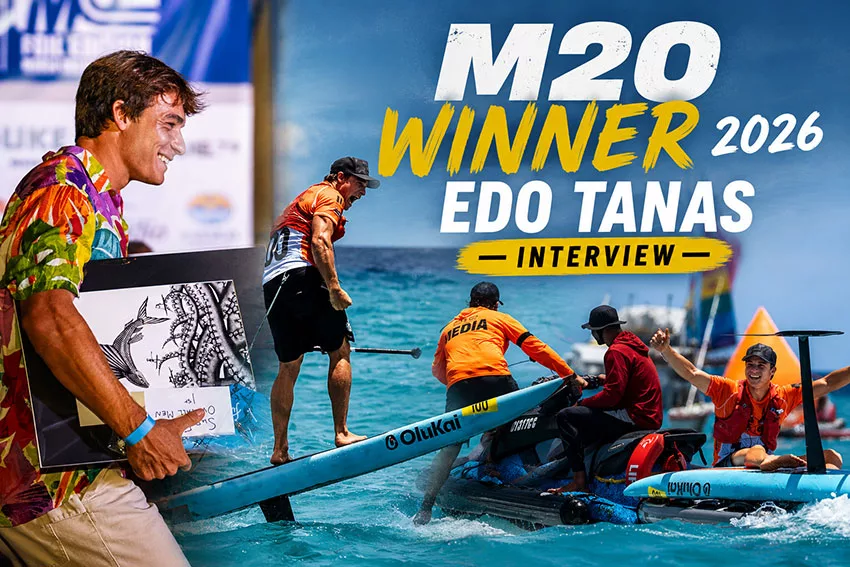
Fresh off his victory at the 2026 Molokai2Oahu (M2O), Edo Tanas once again proved why he is one of the world’s premier downwind SUP foilers. In challenging Kaiwi Channel conditions, Edo delivered a composed and commanding performance to claim one of the sport’s most prestigious titles. Following his impressive win, we reached out to Edo to learn more about his race, his strategy, and what it means to add another M2O victory to his résumé.
Aloha Edo, first and foremost congratulations on your third consecutive victory across the Kaiwi Channel. Before we talk about that achievement, we’d like to relive the race from your perspective. We saw that the start was slow and you were quite a bit behind, but you relentlessly gained ground on the leaders. What was going through your head at that point?
There wasn’t much wind, and I knew it was going to be a struggle. I use a small board, but it’s also a heavy board. I ride a heavier board because it carries more energy, even though it’s harder to pop up. I tried to get up and barely made it. I just stayed relaxed, and eventually I was able to get flying after a slow start. From there, I did everything I could to stay with the front group. One of my biggest strengths is my fitness, and I knew that would help me as the race went on.
When you caught up with the leaders, we noticed on DotVision that you and some of the other front-runners were staying very close to the blue line on the course chart. Was that by chance, or do you plot your line beforehand?
I usually do for races like Maui2Molokai or Kamalo, but for M2O I didn’t. I was simply trying to maximize where the best bumps were. I wasn’t following a pre-planned line.
Can you break down the race course for us? Which sections are the most critical, where you not only have to avoid mistakes but can really make the difference?
Normally, I divide the course into four different sections, but this year was different because the wind was so light. We had very little wind, small chop, and long-period south swell.
From the start to about the middle of the course, I focused on using the south swell. The south swell interacts with the trade swell and constantly pushes you south. It’s all about finding the balance between catching those swells while pumping your way back to the north, because the ocean is always trying to push you south.
After the middle of the course, it became much more technical because of the backwash coming off China Wall. Everything gets really messy there, and you have to make the right decisions. That’s where I was able to create the gap.
Going into the race, the story was all about you, Kai Thompson, and Kane DeWilde. But we also saw the Tahitian riders emerge as dark horses. Were you expecting that?
I actually saw that coming. Kai and Kane are incredibly good in strong wind, but the Tahitian guys have amazing endurance and fitness. They’re also used to riding smaller bumps in Tahiti. Different conditions suit different athletes, and this year the conditions allowed them to really shine.
Gear obviously plays a role. I’m sure you were riding different equipment than last year, but with three consecutive wins it’s clear that skill is the biggest factor. You must be doing something differently than everyone else. What is it?
I think it’s my training. I do a lot of fitness work and cross-training. I’m always way over-prepared physically. When it’s really windy, you don’t need as much fitness because the ocean does more of the work. But in conditions like this year, fitness becomes a huge advantage.
That brings us back to your heavy board. While everyone seems to be in an arms race to build lighter boards, you deliberately ride a heavier one. Why?
I think that’s one of the really cool things about downwind foiling. Every year there are different theories about what’s actually faster. First it was all about board size, and now people are looking more at weight distribution.
My board is probably five to ten pounds heavier than most, but that weight is concentrated around the mast. I think weight distribution is really where it’s at.
Speaking of three consecutive victories: you’re now part of a very exclusive club of only a handful of athletes who have won this crossing three years in a row. What does that mean to you? Did you even know that?
I actually didn’t know that. It means a lot to me to be part of that group. It’s really cool to hear, and it’s nice to know that it still means something.
It also shows how hard I had to work to win this race three times in a row and create that kind of gap to everyone else. It means a lot.
You’ve built quite a reputation over the last four years. Where do you see Edo Tanas going from here?
I’m only 23 years old, so I still have so much ahead of me. My goal is to stay at the front of the sport and hopefully help take it in a great direction. I want to make more appearances, inspire more people, and show the world what this sport is all about.
Where do you see the sport’s biggest growth potential? We now have grassroots initiatives like the Downwind Foil Tour and the SFT. What do you think they need?
I feel like the Hawaii races are still the most prestigious and the best organized events in SUP foiling.
The tours are a great start, but they’re not yet at the level where they have global recognition. They need more exposure and more sponsors to become truly relevant. Hawaii is still the peak when it comes to downwind conditions, and there are much bigger distances to cover here. I think the future is still being written.
Talking about endurance, the legendary SUP Days crossings used to take around four hours. Could you imagine a foil race lasting that long?
Absolutely. I could see something like the Tour de France with multiple stages, or even island-to-island races similar to the Hawaiian sailing canoe events.
Anything else you’d like to add?
I’m really on a mission now to help grow the sport. I want to make downwind foiling more accessible through my coaching and make it easier for more people to get into it.
Thank you very much for your time, Edo. We wish you continued success and already look forward to seeing you back on the start line at the 2027 Molokai2Oahu.
Do you enjoy interviews like this and would want to see more? Help the Stand Up Magazin getting more exposure to stand out athletes like Edo and become a patron of our work.

Online Subscription
Are you enjoying the content of the Stand Up Magazin?
With a subscription, you help secure the future of Stand Up Magazin.
Become a patron and supporter with your subscription.
Your subscription is an annual contribution and renews automatically.