
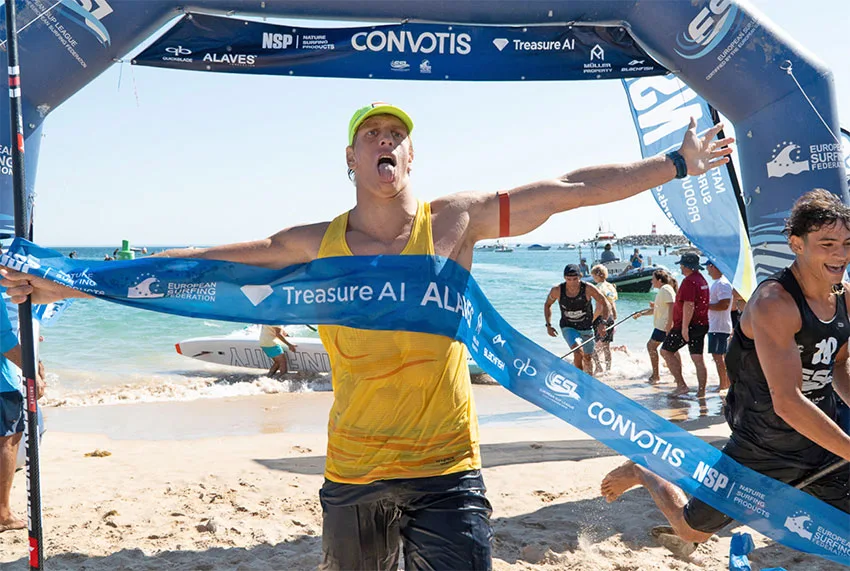
Donato Freens has made SUP racing history. The Dutch athlete is the first-ever European SUP League (ESL) champion, securing the inaugural season title after a demanding series of races across Europe.
For Freens, the title represents more than another trophy. Behind the success are years of hard work, personal sacrifices and the support of his family, coaches and sponsors.
With the European Championships and ICF World Championships approaching, there is little time to celebrate.
We caught up with Freens to discuss his historic victory, the challenges of the ESL season, the financial realities of professional SUP racing and his ambitions for 2027.
First of all: Congratulations! What does it mean to you to be the very first ESL Champion?
It has been a very emotional win for me. There is a whole world behind the scenes that people don’t always see, with struggles inside and outside of SUP, difficult moments, sacrifices and a lot of uncertainty.
For me, one of the biggest things is having people around me who believe in me. My parents, trainer Giorgos, my coach Angelo and the people close to me have supported me through a lot. They see the work behind the results, not just the podiums.
My parents especially have been there throughout the whole journey. They have supported me through the highs and lows, the travel, the uncertainty and all the sacrifices that come with trying to build a career in this sport.
We have dreams together and we know what we are chasing and where we want to go. Winning the first ESL Season Title feels like confirmation that we are moving in the right direction.
At the same time, it doesn’t feel like the end of anything. It makes me even more curious to see where I stand in the upcoming races against the best athletes in the world.
Can you recap the ESL season for us a bit, what were some of the highlights?
The whole season had different challenges. Some races suited me better than others and I think that is what made the overall title special. To win a tour, you cannot just be good on one type of course or in one set of conditions. You have to keep showing up.
Santa Pola was probably my favorite in terms of racing. I felt it had the highest level of competition and the conditions really tested us. Those are the races I enjoy because you immediately see where your level is.
I also really enjoyed Taranto in Italy. The people there were amazing, the atmosphere was great and of course managing to take double gold made it a very special weekend for me.
The final was probably the most emotional moment. Everything came down to the technical race and there was a lot on the line. Being able to perform under that pressure and finish the season on top is something I will remember for a long time.
Some of the race dates were quite spaced out. How did you stay focused and fit during the longer breaks?
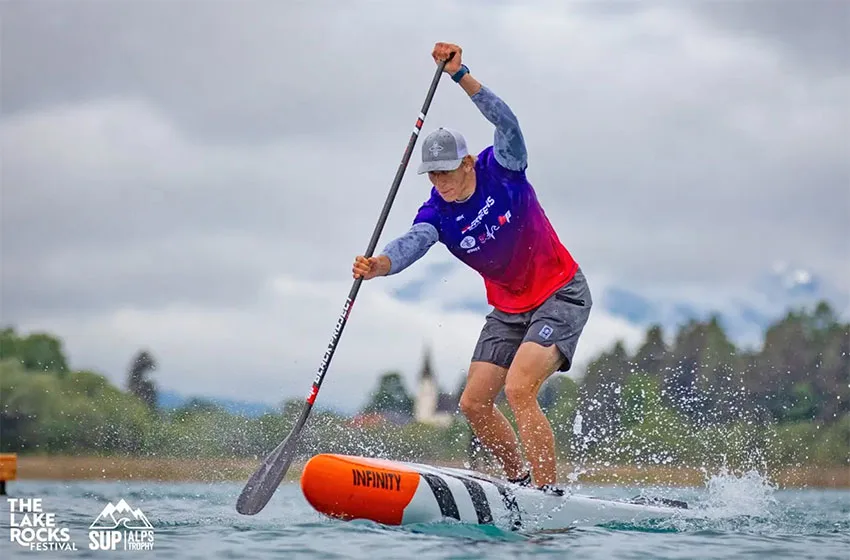
For me the ESL was part of a much bigger season, so there was never really a period where I could switch off completely.
Between the ESL races I was racing other international events, training and constantly working towards the next goal. Our team tries to look at the whole season instead of preparing for every event separately.
The difficult part is actually managing fatigue. You want to stay sharp for the ESL, but at the same time there are World Cups, European Championships and World Championships that you also want to perform at.
Mentally I try not to think too far ahead. I focus on the next training block or the next race and then move forward from there.
How do you see the level of interest in the ESL on the ground? Is the impression that it is mainly a Spanish affair correct?
I understand why it can look like a Spanish affair from the outside, but I think there is a little more behind it.
A big reason for the strong Spanish participation is Deportivo Parres. They are a very powerful SUP community and they support the tour strongly, so naturally you see a lot of Spanish athletes involved.
But you see the same effect in other countries where there is a strong local community behind an event. RTW Raciborz in Poland, Taranto SUP Academy in Italy and Deportivo Parres in Spain are good examples. These communities are passionate about the sport and they bring a lot of athletes to the start line.
So for me, the participation is not only about nationality. It is also about how strong the local SUP community is around each race.
That is actually one of the strengths of the ESL. When you have a strong club or academy behind a stop, you immediately feel that energy on the ground.
What do you think should happen to entice more athletes to follow the full tour?
I think the biggest things are calendar planning, prize money and support for traveling athletes.
Athletes need to know the calendar early. If the dates are announced far enough in advance, we can actually plan the season around the tour instead of trying to fit races into an already full schedule.
There also needs to be a strong reason to follow the whole series. A meaningful overall prize purse, travel support, accommodation partnerships or start-money incentives for athletes who commit to the complete tour could make a big difference.
I also think continuing to work closely with strong local clubs and communities is very important. They are a huge part of what makes certain stops successful.
The sport has many professional-level athletes, but financially we are still far away from being a fully professional sport. If following a tour costs more than an athlete can realistically earn back, it becomes difficult, even if they really want to race.
The ESL had prize money advertised. As a champion, were you able to use some of that money to attend other events?
Absolutely. Prize money in SUP is not just a bonus. For most athletes it goes straight back into the season.
Flights, board transport, rental cars, accommodation, food and race entries add up very quickly. Especially when you are traveling almost every week.
So yes, the money I earn from racing helps me get to the next event. I am basically reinvesting it into my career.
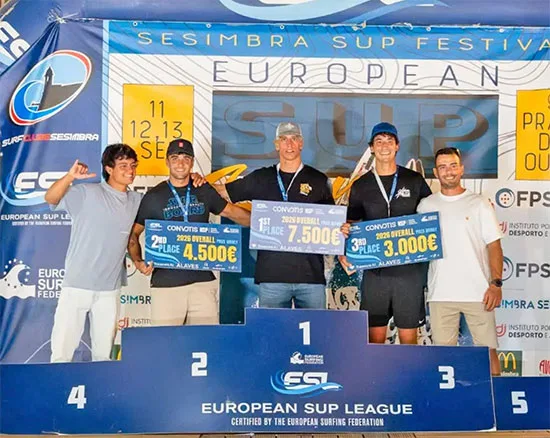
That is why I think prize money is so important for the ecosystem of the sport. It allows athletes to keep racing, which gives events stronger fields, gives sponsors more exposure and ultimately helps the sport grow.
📸 ESL
Infinity has been a great sponsor for you. How did Infinity help you through the season?
Infinity has been a huge part of it.
Of course they give me equipment that I genuinely believe is some of the fastest equipment in the sport, but the relationship goes much further than simply receiving a board.
Dave and the people around Infinity believe in me and in what I am trying to achieve. Having that support behind you makes a big difference, especially during the difficult periods of a season.
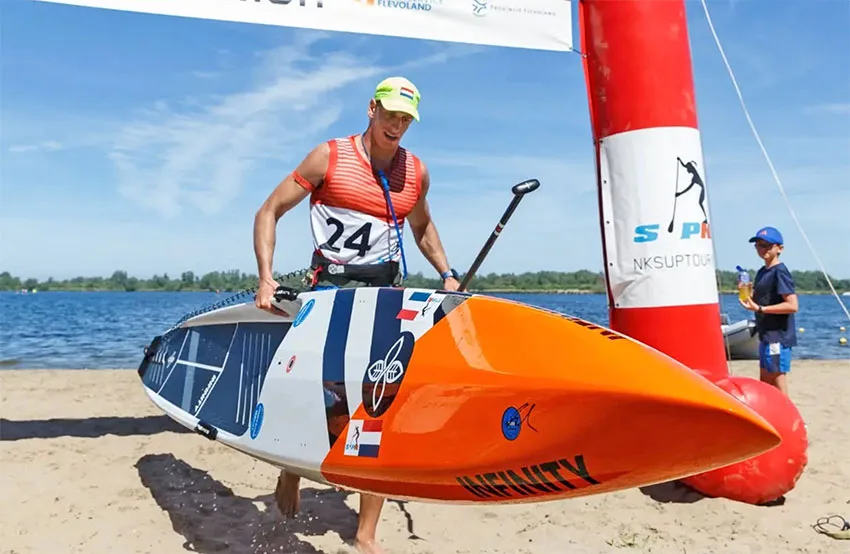
They have helped make it possible for me to travel, race internationally and keep chasing these goals.
And again, that sits alongside the support I get from my parents as well as Giorgos and Angelo. When I am standing on the podium, I am not really standing there alone. There are a lot of people behind that result.
That is something I am very grateful for.
What other events are you going to attend before the ICF Worlds in Italy?
The season is definitely not finished yet.
Straight after the ESL final I am heading to Greece for the European Championships and another World Cup. After that the focus continues towards the ICF World Championships in Italy.
I am really excited for these next races because the level will be extremely high. Winning the ESL gives me confidence, but now I want to see where I stand when we bring together many of the strongest paddlers in the world.
That is the exciting part for me.
What are you expecting from the ICF in the future? What direction would you like to see the sport going?
I would like to see SUP become more unified and easier to understand.
Right now we have different organizations, championships, tours and ranking systems. For athletes who have been in the sport for years, we understand it, but for someone outside of SUP it can be confusing.
I think the ICF has the ability to bring a lot of structure, professionalism and international recognition to the sport.
What I would like to see is a clear international calendar, strong World Cups, meaningful rankings and a pathway where athletes know exactly what they are competing towards.
At the same time, I hope SUP keeps its identity. We don’t want to lose the culture and community that made the sport special in the first place.
The dream for many people is obviously the Olympic Games. I think that would be massive for SUP, but we should also make sure we build a strong professional sport regardless of whether or when that happens.
Do you hear anything from the ISA in terms of SUP? Are you in touch with the Dutch Surfing Federation?
Personally, I don’t hear a lot from the ISA at the moment regarding SUP.
I grew up competing within that side of the sport as well, so I have a lot of respect for what the ISA has done for SUP historically, especially through the World Championships.
At the moment, though, most of my international racing is focused around the ICF, ESL, EuroTour and other major international events.
In the Netherlands I am in contact with the federation and I definitely think there is potential to improve the pathway for Dutch SUP athletes.
For a small country we have produced some very strong paddlers, and I would love to see more structure around the next generation. The Ziets family in the surfing are doing a lot of heavy lifting and representing the Netherlands very well.
What are your personal SUP goals and plans for 2027?
For 2027 I want to take another step towards becoming the best paddler in the world.
I don’t want to focus too much on one specific ranking or one specific title because there are many important races in SUP. My goal is to become an athlete who is capable of winning anywhere, whether it is technical racing, long distance or sprinting.
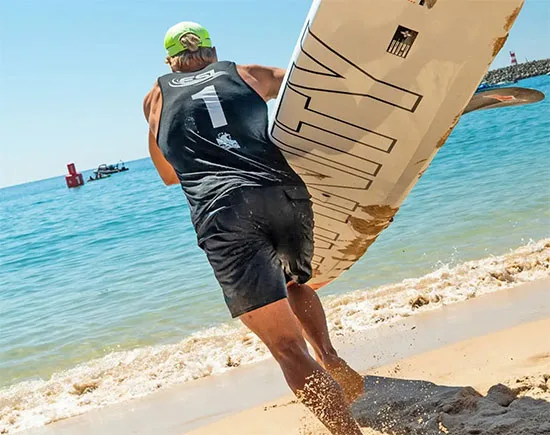
📸 ESL | Full blast into the next season.
I want to keep improving physically, technically and mentally.
The ESL title is something I am incredibly proud of, but it also makes me hungry. I know there are still areas where I can become much better.
The long-term goal is simple. I want to see how far I can take this.
I have my parents and Coaches Giorgos, and Angelo and the rest of my team around me who believe in that dream, and as long as we feel we are moving forward, I am going to keep chasing it.
Thank you so much Donato for your time.
Donato and the Stand Up Magazin are part of the same ECO system that is sustained by the participation and support of everybody involved. We imagine a large subscriber / member base, we would be able to give something back to Donato for his future trip.
Become a supporting member of our work, support us, supporting others.

Online Subscription
Are you enjoying the content of the Stand Up Magazin?
With a subscription, you help secure the future of Stand Up Magazin.
Become a patron and supporter with your subscription.
Your subscription is an annual contribution and renews automatically.