
What Stood Out to Us from Hood River
Parawings everywhere, new foil-assist systems, more accessories and an industry that seems to be moving faster than ever. We were not at the AWSI Board Sports Expo in Hood River, but thanks to surprisingly extensive media coverage, we still got a pretty good look at what was happening. And perhaps the biggest takeaway is this: Trade shows might not be dead after all.
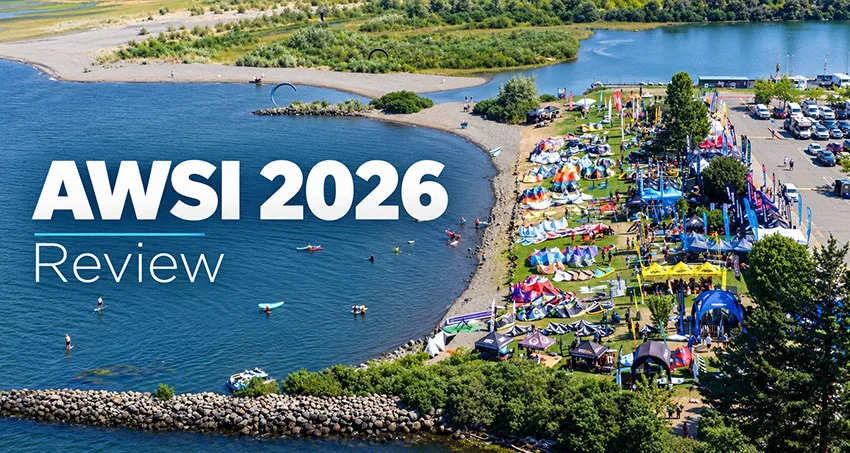
The AWSI Board Sports Expo has become one of the most important annual meeting points for the wind and foil sports industry in North America. The 2026 edition took place September 9–11 in Hood River, Oregon, bringing brands, distributors, retailers, athletes and media together in Hood River the number one destination for Wind Sports on the US Mainland.
This is not a consumer show, the AWSI is a B2B event. The Port of Hood River expected roughly 600 participants around the trade show, which is a substantial concentration of people for an industry as specialized as ours.
Judging from what we could see from Maui, there was a lot going on.
Watching AWSI from afar
For those who couldn’t attend, the online coverage this year was actually very good.
One of our favorites was Foil Rat, whose steady stream of videos and short product introductions provided a comprehensive walk through the show.
There were several other media outlets and individuals producing content as well, and collectively they did an excellent job. The AWSI’s own coverage offered plenty of information too, although we occasionally found the content a little hectic and hard to take in.
But when you combined everything — official coverage, independent videos, Instagram clips, interviews and brand presentations — somebody sitting thousands of miles away could develop a reasonably good picture of where the market is heading, and one trend was impossible to miss.
Parawing, Parawing and more Parawing
If there was one product category dominating the conversation, it was once again the Parawing.
The speed at which this segment has grown is remarkable. What started with only a handful of products 2 years ago has quickly turned into an increasingly crowded market, and AWSI brought two more major names into the game.
Armstrong finally answered the calls of many of its customers and introduced its own Parawing.
The most interesting element for us was the bar and line system, particularly the clever possibility of shortening the A-line to regulate the power and behavior of the canopy. That is exactly the type of development we have been watching closely.
Cabrinha also entered the Parawing market and put particular emphasis on its lightweight bar.
One statement during the presentation caught our attention, however. When a representative essentially acknowledged on camera that maximum stashability was not the primary design objective, we immediately raised an eyebrow.
For us, stashability remains one of the fundamental reasons for using a Parawing.
If you compromise that characteristic, you are either targeting a somewhat different type of rider — a market that may still have to develop — or you are compromising one of the product category’s biggest advantages.
It will be interesting to see where this goes.
One Parawing that particularly caught our attention was the Naish Hatch.
The canopy is obviously important, but increasingly we find ourselves looking at the bar first. Naish appears to have put considerable thought into this part of the system, with the J-shaped bar and integrated harness-line concept standing out among the products we saw.
This reinforces something we have mentioned repeatedly in previous Stand Up Magazin articles:
The next big Parawing development might not come from the canopy. It might come from the bar and line system.
Canopy stability — especially in gusty, difficult wind — remains hugely important. But as the aerodynamic differences between products become smaller, ergonomics, de-power possibilities, bar shape, line management and the ability to transition seamlessly between powered riding and free foiling could become major differentiators.
There are already a lot of Parawings on the market.
There are a few remaining holdouts and industry giant Starboard is surprisingly one of them. NeilPryde is another but Maui insiders know that NeilPryde has been working with several prototypes, so we would be surprised if the brand stayed out of this category for much longer.
The Parawing arms race is far from over.
Has the actual foil hardware taken a back seat?
With so much attention focused on Parawings, we almost had the feeling that the traditional foil hardware — boards, masts and wings — was taking a bit of a back seat. That doesn’t mean development has stopped.
One interesting development was CODE Foils moving into Foilboards, expanding beyond the foil hardware for which the company has become known. This is interesting for the aspect that CODE and its makers have a decade long relationship with Sunova that dates back into the SUP Days.
There was also evidence of consolidation within the industry, with Starboard bringing AK more closely under the Starboard umbrella.
Both developments are interesting for different reasons. The foil market has matured considerably, and companies increasingly appear to be thinking in terms of complete ecosystems rather than isolated products.
RIIFT and the explosion of Foil Assist
Another product that immediately got our attention was RIIFT, a new Australian Foil Assist system launched at AWSI.
The concept is interesting because RIIFT takes integration into the board seriously. Instead of simply attaching another external unit underneath the board, its carbon track system incorporates the power-system architecture directly into compatible boards. A blank can be installed when the board is ridden without assistance, allowing the same board to function powered or un-powered.
But there is an obvious hurdle.
To make such a system work, RIIFT first needs board manufacturers and shapers to build compatible boards.
That is is something the RIIFT makers were working on very hard prior to the launch. In many ways it reminds us of what happened following the introduction of the newer Foil Drive generations. Suddenly we started seeing trench boards and other shapes specifically designed around Foil Drive installations. Most foil brands jumped on board producing compatible masts as well.
The relationship between boards and propulsion systems is becoming increasingly integrated.
And when you consider where we were only a few years ago, the speed of this development is astonishing.
When Foil Drive introduced its early systems, Foil Assist still felt like a niche within a niche. Today there are numerous approaches to adding electric assistance to a foilboard, ranging from removable systems to highly integrated solutions.
RIIFT is simply the latest interpretation.
The downside remains the price. Once a consumer combines the electronics, compatible board, foil and the rest of the equipment necessary for a complete setup, getting well beyond the $5,000 mark isn’t difficult.
Foil Assist is becoming better. – Affordable it is not.
Don’t overlook the accessories
Something else caught our attention at AWSI that is much less glamorous than a new foil or Parawing but possibly just as relevant: accessories.
Ride Engine in particular showed how much opportunity is emerging around Parawing and Downwind SUP.
We are no longer just talking about a leash and a simple waist belt. Stash belts, vests, modular chest systems, hydration solutions and mounting options for safety and camera equipment are becoming a product category of their own.
Downwind SUP and Parawing riders are traveling increasingly long distances offshore. They carry phones, VHF radios, hydration, cameras, emergency equipment and sometimes a packed-away wing.
Where do you put all of it without interfering with your ride?
There are some genuinely good ideas appearing in this space, and we suspect accessories will become a much more interesting category over the next few years.
One Question Remains: Who Relevant Are Trade Shows?
Perhaps the most interesting question after watching AWSI from afar had nothing to do with a particular product.
Does our industry still need trade shows?
This question is particularly interesting for us at the Stand Up Magazin as we attended the boot Show in Düsseldorf regularly since 2013 and observed a gradual decline in industry participation.
B2B trade shows have been under pressure for years. Products can be launched on Instagram. Dealers can attend Zoom presentations. Journalists receive digital press kits. YouTube can provide a detailed product presentation within hours of a launch.
Sitting in Maui, we were able to watch dozens of products, hear explanations directly from designers and brand representatives and get a surprisingly broad overview of what was happening in Hood River.
But there was also a downside: Digital Content Content Overload, and loosing the human touch.
You watch one video, then another appears. You discover one product only to realize that three other companies introduced something similar. You see an interesting accessory in the background of somebody’s Instagram Story and things start to drown out.
Even with excellent online coverage the danger of having content overload is real.
And perhaps that is exactly why AWSI still matters.
For somebody working professionally in this industry, spending a full day walking from booth to booth, talking directly with designers, distributors and retailers and actually touching the products may provide more understanding of where the market is heading than hours of scrolling through social media.
There is another element that the internet cannot reproduce very well either: The conversations between humans.
What are retailers actually ordering? Which products are people genuinely excited about? Which brands are gaining momentum? What are distributors worried about? And which heavily promoted product is everybody politely walking past?
You don’t necessarily learn those things from a press release.
Maybe Hood River in 2027
Our conclusion after AWSI 2026 is therefore slightly ironic. The online coverage was good enough that we almost felt as though we had been there.
But it also convinced us that we probably should have been there.
For the Stand Up Magazin, the overlap between SUP, downwind foiling, Parawing, wing foiling and Foil Assist has become too large to treat these categories separately anymore. AWSI brings an enormous part of that industry together in one relatively small place.
So while we watched Hood River from Maui this year, AWSI 2027 has definitely made its way onto our radar.
Because sometimes the best way to understand where an industry is going is still the old-fashioned one: Walk around, look at the gear, ask questions — and talk to the people who are building it.
There is one problem: Travel costs are not cheap and online media like ours are facing more and more challenges getting budgets for such endeavors. There is not much money in our industry and advertising clients don’t have loose pockets like in the past.
This is why we are reaching out to our readers to become subscribers and active members of our Stand Up Magazin community to continue putting out content and possibly travel to Hood River in 2027.

Online Subscription
Are you enjoying the content of the Stand Up Magazin?
With a subscription, you help secure the future of Stand Up Magazin.
Become a patron and supporter with your subscription.
Your subscription is an annual contribution and renews automatically.