
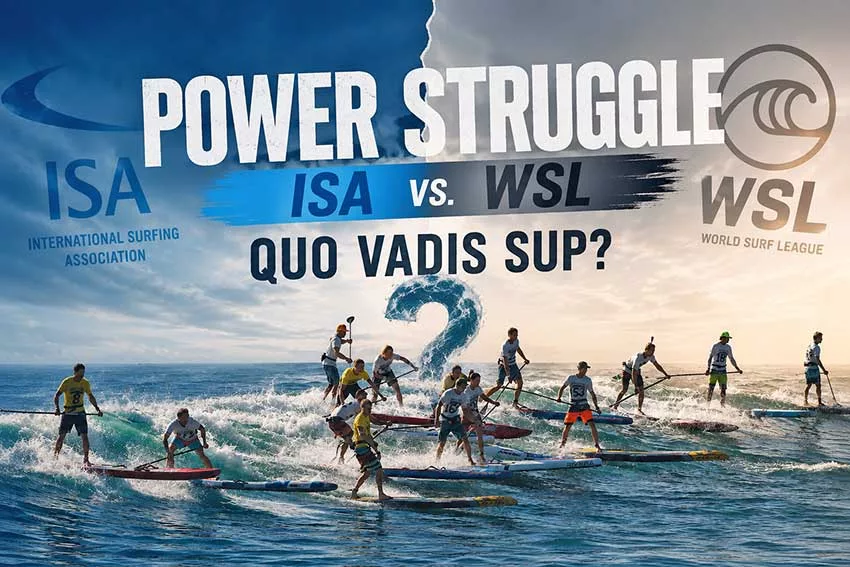
The growing dispute between the International Surfing Association and the World Surf League is officially about surfing qualification for Los Angeles 2028. However, the conflict could also have wider implications for Stand Up Paddling and the ISA’s ambition to bring SUP into the Olympic Games.
A public power struggle has developed between the International Surfing Association and the World Surf League over the qualification system for surfing at the Los Angeles 2028 Olympic Games.
According to a detailed report by The Inertia, relations between the two organizations have deteriorated to the point where communication is now reportedly infrequent and largely conducted in writing. The most visible consequence is a scheduling conflict between a newly announced WSL Championship Tour event at Cloud 9 and the ISA’s first Olympic qualification event in Peru.
The dispute is primarily about who controls Olympic qualification, how much influence the professional Championship Tour should have and whether the world’s best surfers should be required to compete in ISA events to secure their Olympic eligibility.
For the SUP community, however, the conflict raises another important question:
Can the ISA realistically lead Stand Up Paddling into the Olympics while it is struggling to maintain cooperation with the professional surfing world?
ISA and WSL Fight Over Olympic Qualification
The ISA spent decades campaigning for surfing’s inclusion in the Olympic Games and remains the international federation recognized for surfing at Olympic level.
The WSL, meanwhile, operates the world’s leading professional surfing tour. Its Championship Tour includes most of the sport’s highest-profile athletes and provides the professional platform, media exposure and commercial structure surrounding elite surfing.
For Tokyo 2020 and Paris 2024, the ISA and WSL developed a qualification system that combined Championship Tour results with ISA competitions such as the World Surfing Games.
That cooperation has now broken down.
For Los Angeles 2028, the ISA initially proposed a qualification system that placed greater importance on the World Surfing Games and continental championships while reducing the number of positions available through the WSL Championship Tour.
A number of leading professional surfers publicly criticized the proposal. The ISA later amended the qualification system and restored some Championship Tour opportunities, but the compromise apparently failed to repair the relationship.
The WSL subsequently announced a possible Championship Tour event at Cloud 9 during the same period as the ISA’s first Olympic qualifier in Peru. Athletes could therefore be forced to choose between earning Championship Tour points and prize money or representing their countries in an Olympic qualification event.
Familiar Problems for the SUP Community
The situation will sound familiar to Stand Up Paddlers.
For years, SUP has been caught between two international federations: the ISA and the International Canoe Federation.
Both organizations claimed the right to govern the sport, resulting in a long and expensive dispute before the Court of Arbitration for Sport.
The 2020 CAS decision rejected the ISA’s attempt to become the exclusive global governing body for SUP. Both the ISA and ICF were permitted to continue organizing SUP competitions. However, the decision identified the ISA as the federation responsible for administering SUP at Olympic level under the terms of the ruling.
The ICF interpreted the decision differently, emphasizing that it remained free to organize SUP events and arguing that the final decision over Olympic governance ultimately rests with the International Olympic Committee.
The result is the divided structure we still have today: two World Championships, two sets of international rules, different national federation systems and athletes regularly competing under both organizations.
ISA Has the Olympic Mandate, but ICF Has Built the Bigger Racing Structure
Stand Up Magazin has followed this governance conflict for many years.
The ISA has the historical and cultural argument. SUP developed from surfing and board-sport culture, and the ISA was involved in international SUP competition before the ICF entered the sport. It also holds the strongest legal position concerning a future Olympic pathway.
The ICF, however, has built a more consistent racing program. It organizes annual World Championships, allows broad participation, operates a World Ranking Series and usually announces major events well in advance.
The ISA’s SUP activities have often been less predictable. World Championship dates and locations have sometimes been announced late, while communication with athletes and the wider SUP industry has remained limited.
Stand Up Magazin raised this concern following the creation of the ISA SUP Commission in 2024. Although the commission included well-known athletes, questions remained about its actual responsibilities, communication and ability to unify the sport.
In a later comparison of the two organizations, we described the fundamental contradiction facing SUP: the ICF offers consistency and a substantial international competition structure, while the ISA controls the more credible Olympic pathway but has struggled to provide comparable long-term reliability.
What the ISA–WSL Feud Could Mean for Olympic SUP
The conflict with the WSL does not automatically end the ISA’s Olympic ambitions for Stand Up Paddling. However, it reveals several risks that should concern the SUP community.
1. The ISA’s priority remains surfing
Shortboard surfing is already an Olympic discipline and therefore remains the ISA’s most valuable sporting and commercial asset.
When disagreements arise over qualification places, athlete quotas, schedules or Olympic revenue, the ISA is likely to concentrate first on protecting surfing’s existing position.
SUP remains an additional discipline seeking admission to the Games. It does not currently have the same institutional importance.
The IOC rejected the ISA’s proposal to add longboard surfing to Los Angeles 2028 and also declined to increase surfing’s athlete quota. That decision already demonstrated how difficult it is for the ISA to add another discipline or secure additional Olympic positions.
2. Olympic credibility depends on cooperation
The IOC generally wants the world’s best athletes at the Olympic Games.
For surfing, that requires cooperation between the ISA and WSL. For SUP, it would require cooperation between the ISA, national federations, athletes, major independent events and potentially the ICF.
If the ISA cannot maintain a functional relationship with surfing’s main professional tour, the IOC may question whether it can unite the even more fragmented SUP racing world.
3. SUP athletes could face the same scheduling conflicts
The surfing dispute demonstrates what happens when an international federation and a professional competition organizer build calendars independently.
SUP athletes already face similar choices. ISA and ICF World Championships, professional races, continental championships and commercial tours compete for limited dates, travel budgets and elite participation.
An Olympic qualification system controlled by the ISA could increase those conflicts unless the organization begins coordinating much more closely with the rest of the SUP racing calendar.
4. The best athletes must be part of the process
The WSL controversy also shows the danger of developing qualification systems without sufficient athlete support.
Any future Olympic SUP format must be credible to the world’s leading paddlers. Qualification should reward elite performance without forcing athletes to attend poorly timed events simply to satisfy federation politics.
SUP cannot afford an Olympic process in which athletes must choose between an ISA qualifier, an ICF World Championship and an established professional race carrying significant prize money.
5. Institutional conflict could delay SUP even further
SUP will not be included at Los Angeles 2028. The ISA has previously identified Brisbane 2032 as its next major opportunity, but even that target appears uncertain.
Stand Up Magazin has repeatedly questioned how SUP could be added when the IOC is limiting athlete quotas and asking federations to work within their existing number of disciplines and participants.
The ISA–WSL conflict creates an additional distraction at precisely the time when the ISA would need to prepare a unified, technically detailed and politically convincing proposal for SUP.
Could the ICF Take Advantage?
The dispute may indirectly strengthen the ICF’s argument that it is better equipped to manage international SUP racing.
The ICF can point to its event calendar, national federation network, ranking system and annual World Championships. Its planned transition toward the broader “Paddle Worldwide” identity also signals an intention to represent paddle sports beyond traditional canoeing and kayaking.
However, this does not mean the ICF can simply take SUP to the Olympics.
The CAS award did not recognize the ICF as SUP’s Olympic federation. It allowed the organization to continue developing and organizing the sport outside the Olympic framework while assigning the Olympic-level role to the ISA under the award’s terms.
The ICF may have the larger and more reliable SUP competition structure, but the ISA continues to hold the stronger Olympic card.
This was our analysis with Connor Baxter when we had the long awaited CAS decision. This was 5 years ago.
The SUP World was waiting a long time for this decision and we all thought SUP Olympic inclusion was imminent.
It was a big moment and we were all very hopeful.
Stand Up Magazin Opinion: SUP Needs Cooperation, Not Another Power Struggle
The central lesson from the ISA–WSL dispute is not that the ISA should control less or that another organization should automatically take over.
The lesson is that international federations cannot build successful Olympic sports through institutional power struggles alone.
The ISA may have the legal and historical claim to represent SUP at Olympic level, but that position comes with responsibility. It must communicate regularly, announce events early, involve athletes in major decisions and coordinate with the organizations already investing in SUP racing.
At the same time, the ICF must recognize that SUP is not simply another form of canoe racing. The sport has its own culture, equipment, ocean heritage and professional ecosystem.
The athletes should not have to choose sides.
Many of the world’s leading paddlers already compete at both ISA and ICF events. Their approach is more practical than the politics surrounding them: they want strong races, fair rules, reliable calendars and opportunities to represent their countries.
A Warning for SUP’s Olympic Dream
The ISA–WSL conflict is officially a surfing story, but it should serve as a warning for Stand Up Paddling.
The ISA is trying to protect its authority over Olympic surfing while also presenting itself as the federation capable of bringing SUP into the Games. The ICF continues to invest heavily in SUP and has built a large international race structure, despite lacking the same recognized Olympic pathway.
Unless the organizations find a way to cooperate—or at least coordinate—the biggest loser will not be the ISA, the ICF or the WSL.
It will be the athletes.
SUP’s Olympic campaign needs one credible qualification structure, one coordinated international calendar and the participation of the sport’s best paddlers. Without those elements, the Olympic rings will remain a political promise rather than a realistic destination.
Do you appreciate independent journalism like this? The Stand Up Magazin depends on the support from readers like you. Please become a patron of our work.

Online Subscription
Are you enjoying the content of the Stand Up Magazin?
With a subscription, you help secure the future of Stand Up Magazin.
Become a patron and supporter with your subscription.
Your subscription is an annual contribution and renews automatically.