
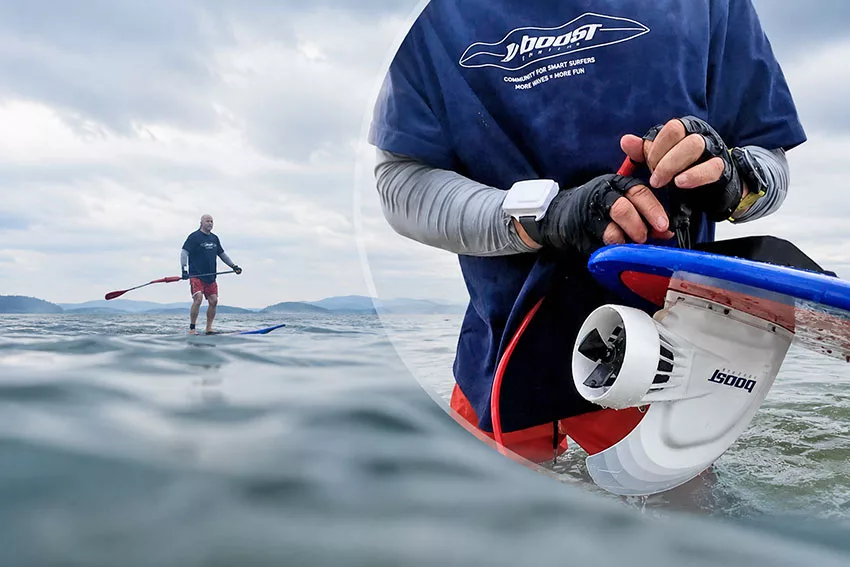
Why Electric Assist Is Gaining Fans Among Paddlers
For many stand up paddlers, the beauty of SUP lies in the challenge: earning every mile on the water through skill, endurance and fitness. But what happens when wind, currents or simply age start making those miles significantly harder? A growing number of paddlers are discovering a middle ground between pure paddling and powered watersports: electric assist fins.
One product drawing attention in this space is the Boost Fin, an electric fin system that mounts to a stand up paddle board and provides optional propulsion when conditions become demanding. While some paddlers may initially hesitate at the idea of adding power to a SUP, real-world experiences suggest the technology is less about replacing paddling—and more about extending time on the water.
Tackling Wind and Current Without Overdoing It
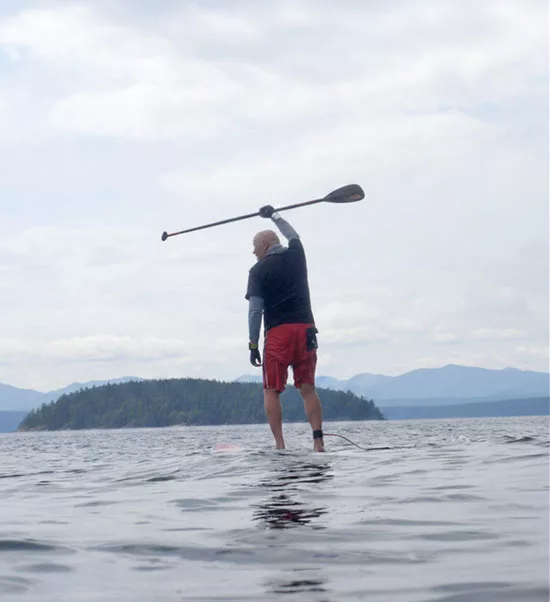
Take the experience of Chris J. from Washington State, a longtime paddler on the challenging waters of the Puget Sound. At 58 years old, Chris still enjoys regular SUP sessions but admits that shoulder fatigue has increasingly become a limiting factor.
Paddling in the Puget Sound means dealing with cold water, strong tidal currents and exposed conditions. The infamous Tacoma Narrows, in particular, is known for currents that can quickly humble even experienced paddlers. Fighting wind and current on the return leg of a paddle session can often turn an enjoyable outing into a physical grind.
Like many experienced paddlers, Chris was initially skeptical about adding a motorized component to his SUP.
“I’m not looking for a motorboat.”
“I still want to earn my miles.”
Instead, his goal was simple: reduce the strain on his shoulders and continue paddling longer without the physical punishment afterward.
A SUP Tool, Not a Replacement for Paddling
After installing the Boost Fin—an attachment that reportedly takes only a few minutes to mount using a standard slide-in fin box adapter—Chris began experimenting with interval-style assistance. Rather than continuously using the motor, he alternated between paddling under his own power and using low-to-medium assistance levels.
The biggest surprise was not increased speed.
Instead, it was the reduced effort needed in difficult conditions.
On the return leg through the Tacoma Narrows current, the fin provided just enough support to take the edge off the resistance. Instead of exhausting himself fighting the current, Chris describes being able to paddle comfortably while still doing the work himself.
For many aging paddlers—or anyone recovering from shoulder strain—this may be where the biggest value lies. Rather than replacing the physical workout, systems like the Boost Fin can help reduce overuse fatigue and extend the number of years paddlers stay active on the water.
Longer Routes Become Possible Again
Another benefit frequently mentioned by paddlers using electric assist systems is increased range.
Spots that once felt too exposed, too far upwind or simply too risky to attempt alone suddenly become realistic again. For paddlers in locations with strong tidal movement or long return sections—such as Hawaii, the Pacific Northwest or many European coastlines—having a backup assist system can also add an extra layer of confidence.
The Boost Fin Plus comes equipped with a 3500 mAh battery, which is rated for approximately 50 minutes of continuous use on a SUP. Riders seeking longer sessions can opt for the Boost Fin Long Range model, featuring a larger 7000 mAh battery for extended runtime. However, many paddlers maximize battery life by using interval assistance rather than constant power.
A Growing Trend in Stand Up Paddling?
At the Stand Up Magazin, we understand why traditional paddlers may initially raise an eyebrow at electric assistance on a SUP. The culture of paddling has always been deeply rooted in self-propulsion and fitness.
At the same time, we also recognize an important reality: if technology helps paddlers stay active longer, paddle farther, reduce injuries and continue enjoying the sport into their 50s, 60s and beyond, it deserves a closer look.
Especially in locations where wind, currents and long-distance paddling are part of everyday sessions, an assist fin may not be about going faster—it may simply be about staying out longer and making the paddle home more enjoyable.
For Chris, that was ultimately the takeaway.
He is not trying to keep up with younger paddlers or turn his SUP into a motorized craft. He simply wants to keep doing what he loves—without paying for it with sore joints the next day.
And for many stand up paddlers, that sounds like a pretty compelling argument.
Product News like this are possible thanks to the support of Industry Partners like boost. If you like to see more news and content, support your favorite watersports Magazin with a contribution.

Online Subscription
Are you enjoying the content of the Stand Up Magazin?
With a subscription, you help secure the future of Stand Up Magazin.
Become a patron and supporter with your subscription.
Your subscription is an annual contribution and renews automatically.