
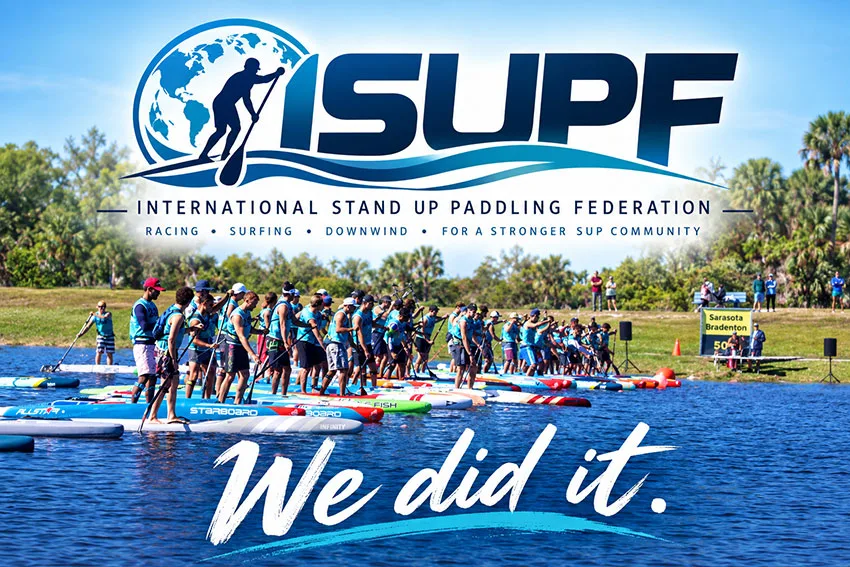
Spoiler alert: We did not in actuality, but we did show the path. Who wants to walk it?
What Would It Take to Create an Independent International SUP Federation?
With the ongoing discussion about an independent SUP Federation, we asked our AI Agent what it would actually take to found and organize an International SUP Federation.
The interesting part is that, on paper, it is actually not that difficult. The bigger question is whether it will be possible to find the right people who are willing to dig in and do the work.
Once you have those people, the real work begins. Regular meetings need to be organized, and with an international group, those meetings need to accommodate everyone’s schedules across different time zones. Decisions need to be made, responsibilities shared and, most importantly, people need to stay committed over the long term.
Our AI Agent sees many of the same challenges we do. But read for yourself:
For years, Stand Up Paddling has found itself between different international sports organizations. SUP racing, SUP surfing and the question of international governance have repeatedly generated discussion within the community.
But what if the SUP community decided that the sport should eventually have an international federation dedicated exclusively to Stand Up Paddling?
Instead of simply asking whether SUP needs its own federation, we wanted to ask a more practical question:
What would it actually take to create one?
The answer might be surprising.
Creating a legitimate grassroots international SUP federation is neither impossible nor necessarily extremely expensive. Achieving international recognition and eventually entering the Olympic sports structure, however, would be a much longer and considerably more difficult journey.
STEP ONE: CREATE THE FEDERATION
One possible home for such an organization would be Switzerland, where many international sporting organizations are based.
Under Swiss law, an association can be established by at least two natural persons and/or legal entities. No minimum starting capital is required. The founders hold an organizational meeting, approve written statutes and appoint the organization’s governing board.
The association then exists as its own legal entity.
For an international SUP federation, however, simply finding two people and filing some documents would clearly not be enough. A credible founding group should be much broader.
A realistic starting target could be:
10–15 respected SUP stakeholders representing approximately 8–12 countries.
These people could include international athletes, race organizers, coaches, officials, national SUP representatives and people who have contributed significantly to the development of Stand Up Paddling.
They would participate as individuals or as representatives of organizations where they have an official mandate.
That distinction is important.
Someone could be a:
Founding Member – Athlete – Nation
without claiming to represent the entire Nation
A person should only be identified as representing a national federation or association when that organization has formally authorized them to do so.
WHAT IS A FOUNDING MEMBER?
The founding members would sign a Founding Declaration and approve the federation’s first statutes at the Constitutive General Assembly.
Their names, countries and backgrounds could permanently remain part of the historical record of the organization. But being a founder should not mean having permanent control. A modern federation should ultimately belong to its members and athletes, with democratic elections determining who governs it.
The original founders should therefore help build the organization—not own it forever.
WHAT WOULD LEVEL ONE COST?
This is perhaps the biggest surprise. There is no minimum capital requirement for forming a Swiss association. The legal act of creating the organization therefore does not require hundreds of thousands of francs. Nevertheless, an international sports federation should not be built with a downloaded template and a €50 logo. It needs professional statutes, governance rules, accounting, insurance, administration and a credible public presence.
Our preliminary Level One budget would therefore look approximately like this:
- Swiss legal and sports-law advice: CHF 3,000–6,000
- Statutes and governance documentation: CHF 1,000–2,000
- Formation and administration: CHF 500–1,000
- Swiss address/administrative services: CHF 1,000–2,000
- Accounting and banking setup: CHF 500–1,000
- Website, domain and email: CHF 1,000–2,000
- Identity/logo: CHF 500–1,000
- Initial insurance: CHF 1,000–2,500
- Founding congress: CHF 1,000–3,000
- Reserve/miscellaneous: CHF 1,000–2,000
That puts a sensible Level One fundraising target at approximately CHF 15,000–20,000.
These are planning estimates rather than official Swiss fees, and proper quotations would be required before establishing the organization.
But the important point remains:
Money would probably not be the biggest obstacle to starting an international SUP federation.
People, credibility and organization would be.
ATHLETES NEED A REAL VOICE
If a new organization is supposed to improve international SUP governance, athlete representation cannot simply be a symbolic committee. (Ed. Note: We seen quite a few of symbolic committees, particularly the ISA one after Copenhagen and the ICF one after China)
We would suggest establishing an Athletes Commission from Day One.
For example, seven elected athlete representatives covering different genders, regions and SUP disciplines.
Eligible athletes could nominate themselves or other eligible athletes, followed by an election in which qualified athletes—not federation officials—choose their representatives.
The definition of a “qualified athlete” would have to be established carefully.
One possible starting point would be athletes who have competed at recognized international SUP competitions during the previous five years, supplemented by clearly defined national-level qualification criteria.
Most importantly, elected athlete representatives should have actual voting rights within the federation’s governing structure.
That principle is already reflected in the standards that international sports organizations are increasingly expected to meet. SportAccord’s current AIMS membership criteria specifically examine athlete representation in governing bodies as part of an international federation’s organizational standards.
THE NEXT JOB: ONE SUP RULEBOOK
Once the organization exists, one of its first responsibilities would be defining the sport it represents.
That means creating an International SUP Rulebook.
There is little reason to reinvent everything.
Existing rules from international federations, established SUP tours, national associations and major independent races could be compared to determine what already works.
The resulting rulebook could initially cover:
- Sprint Racing
- Technical Racing
- Long Distance
- Marathon/Ultra Distance
- SUP Surfing
- Downwind
- Junior Competition
- Open Competition
- Masters
- Para SUP
- Team and Relay Racing
The rules would establish common standards for board classes, race distances, starts, drafting, buoy turns, interference, penalties, protests, safety, equipment control, course design and officiating.
The objective would be simple:
One understandable international SUP rulebook created specifically for Stand Up Paddling.
DON’T START WITH ANOTHER WORLD CHAMPIONSHIP
A new federation would not immediately need another World Championship. In fact, there may be much more value in doing something simpler first.
Recognize existing races. – Create common standards. – Introduce international race sanctioning. – Train officials.
And perhaps most importantly, create one independent SUP World Ranking that allows athletes to collect points at recognized competitions around the world.
That would give a grassroots federation something useful to offer athletes and organizers immediately.
Only after the organization, rules, ranking and international membership have become established would creating its own championship make sense.
LEVEL ONE
The initial goal could therefore be remarkably straightforward:
1. Establish a Swiss nonprofit association.
2. Bring together 10–15 credible founding members from 8–12 countries.
3. Adopt professional statutes and transparent governance rules.
4. Establish an elected Athletes Commission with voting representation.
5. Create International SUP Rules Version 1.0.
6. Build a basic membership, website and administrative structure.
7. Begin accepting national SUP organizations as members.
Estimated initial funding: approximately CHF 15,000–20,000.
At that point, the SUP community would have something tangible.
Not an Olympic federation.
Not yet the internationally recognized governing body.
But a real, legally established international SUP organization from which everything else could grow.
THEN COMES THE MUCH LONGER ROAD
Creating an association and becoming part of the recognized international sporting system are two completely different things.
The current SportAccord/AIMS pathway illustrates the scale of that second challenge.
For a summer sport, an applicant currently needs 60 approved National Federations across at least three continents. Those national organizations are themselves evaluated on criteria including legal registration, statutes, elections, financial statements, national championships, grassroots programs and recognition by their National Olympic Committee or national sports authority.
The international federation must also demonstrate good governance, athlete representation, gender representation, ethics rules, conflict-of-interest policies, anti-doping measures, development programs, audited financial statements and genuine international sporting activity.
And applying isn’t free.
The current AIMS application fee is CHF 25,000 and non-refundable.
Anti-doping would become another important step. WADA provides specific model anti-doping rules for International Federations, and joining the recognized international sports structure would eventually require a serious anti-doping framework rather than simply adding a paragraph about doping to a rulebook.
THE SUP-SPECIFIC PROBLEM
SUP would face another major hurdle that a completely new sport might not.
SportAccord specifically examines whether other organizations already claim governance over a sport. It considers conflicts with existing recognized sporting bodies, membership numbers, national recognition, governance, geographic reach and even previous CAS decisions when determining the legitimacy of an applicant.
For Stand Up Paddling, that question obviously cannot be ignored.
Therefore, an independent SUP federation could not simply create 60 national organizations, submit CHF 25,000 and expect international recognition.
It would have to demonstrate that it had become a legitimate global representative of the sport.
That would take years.
FROM GRASSROOTS TO IOC RECOGNITION
A realistic development path might therefore look something like this:
LEVEL 1 — FOUNDATION
Swiss legal entity, founding members, athletes commission, statutes and international rulebook.
LEVEL 2 — INTERNATIONAL DEVELOPMENT
National member organizations, international ranking, sanctioned events, officials program, youth development and continental representation.
LEVEL 3 — GLOBAL FEDERATION
60+ credible national federations, continental structures, international championships, professional administration, audited finances, athlete programs and a fully developed anti-doping and integrity system.
LEVEL 4 — INTERNATIONAL RECOGNITION
Application to the appropriate recognized international sports structures and demonstration that the organization legitimately governs SUP internationally.
LEVEL 5 — IOC
IOC recognition is ultimately a separate decision. The Olympic Charter provides for the IOC to recognize International Federations, with the IOC determining the recognition procedures and conditions.
Olympic inclusion would be another question again.
SO, COULD THE SUP COMMUNITY ACTUALLY DO IT?
Legally?
Yes.
Financially?
At grassroots level, probably yes.
Organizationally?
That is where the real challenge begins.
Creating the legal federation may require CHF 15,000–20,000 and a relatively small group of committed people.
Creating an organization that athletes, race organizers and national SUP communities around the world actually trust enough to represent them is much harder.
And becoming internationally recognized would be harder still.
But perhaps the most interesting conclusion from looking into the process is this:
The SUP community does not need permission to start organizing itself.
It needs credible people, good statutes, transparent governance, athlete representation, common rules—and the willingness of people from different countries to work together.
End of AI Content. Editors final thoughts: After reading our AI Agents thoughts and findings, we are convinced that the International SUP Community will not be capable of reaching such a high level. We only see two solutions:
Solution One: Paddlers Unite
Still found a Federation and create all the above. Have all the paddlers agree to sanction certain events and only show up at these events. SUP Athletes can shape the sport and its direction but it will only work if they all stand together and only show up at events a SUP Federation will sanction.
Solution Two: Privatize
Find the money to privatize a Pro Tour. SUP Athletes subsequently become contractors for a private organization and are under contract. Sanction races, use the generated content to attract sponsors and media. Basically, do what the APP tried for years and what the WSL has successfully pulled of over the last two decades.
Despite all the enthusiasm and hopes for the sport, we at the Stand Up Magazin have little hope that event the two solutions above will come to reality. Maybe who knows, all of this is not even needed and the sport is just great for what it is right now.
Last thought experiment if you made it this far: Imagine for a moment the Stand Up Magazin had 2000 SUP Enthusiasts paying EUR 5.- per Month, we had a monthly budget of EUR 10K we could put our heart and soul back into the sport. This is as much of a dream as Olympic inclusion of SUP in our live times.
Dare to dream with the Stand Up Magazin right now!

Online Subscription
Are you enjoying the content of the Stand Up Magazin?
With a subscription, you help secure the future of Stand Up Magazin.
Become a patron and supporter with your subscription.
Your subscription is an annual contribution and renews automatically.