
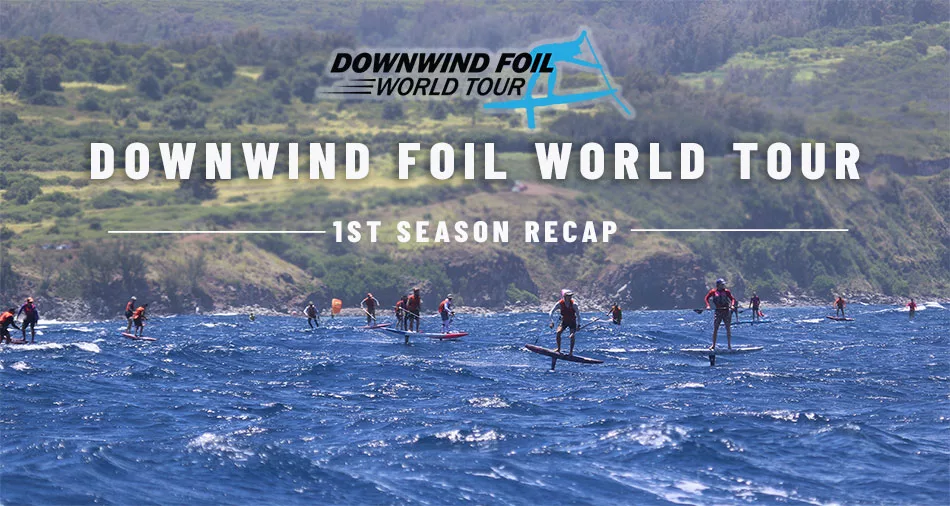
Downwind Foil World Tour: Kai Thompson and Naumi Eychenne Crowned First World No. 1s
The first season of the Downwind Foil World Tour (DWFWT) is in the books. After six races across Europe, Australia and Hawaii, Kai Thompson and Naumi Eychenne have been crowned the first-ever Downwind Foil World Tour number ones.
Launched in late 2025, the tour set out to connect some of the world’s most important downwind foil races through a season-long global ranking. Ten months later, the concept has delivered exactly that: different continents, very different conditions and a championship that remained open until the final races in Hawaii.
For a rapidly developing sport that until recently consisted largely of individual races without an overarching ranking, the inaugural DWFWT season represents an important step toward a more structured international competition circuit.
Six Races Across Three Continents
The 2025/26 Downwind Foil World Tour consisted of six events:
- St Tropez, France – October 7–12, 2025
- Crozon Foil Festival, France – October 14–19, 2025
- West Coast Downwinder, Perth, Australia – November 22, 2025
- The Doctor, Perth, Australia – November 29, 2025
- Maui 2 Molokai (M2M), Hawaii – July 17, 2026
- Molokai 2 Oahu (M2O), Hawaii – July 20, 2026
Only an athlete’s best four results from the six events counted toward the final ranking. The format rewards riders who compete throughout the season while still allowing athletes to miss individual events.
The legendary Molokai 2 Oahu retained its traditional World Championship status and provided a fitting finale to the inaugural tour.
In addition to the global ranking, the DWFWT is developing regional series in Europe, the Americas and Australia/New Zealand/South Africa, creating a potential pathway from regional competition into the international tour.
Kai Thompson Wins Inaugural Men’s Downwind Foil World Tour
The men’s championship developed into an interesting battle between Kai Thompson, Jarrod Snow and Edoardo Tanas, with each rider dominating a different part of the season.
Thompson established himself as the early championship favorite by winning both European events. Victories in St Tropez and Crozon gave him two maximum 100-point scores before the tour moved to Australia.
There, Jarrod Snow answered emphatically. Snow won both the West Coast Downwinder and The Doctor, collecting his own pair of 100-point results and keeping the championship wide open heading into Hawaii.
Then came Edo Tanas.
Edo Tanas Turns the Championship Upside Down in Hawaii
Tanas did not compete in Europe or Australia, but his performance in Hawaii demonstrated just how quickly the rankings could change.
He won both Maui 2 Molokai and Molokai 2 Oahu, scoring 200 points from only two appearances.
The M2O victory was particularly significant, giving Tanas his third consecutive Molokai 2 Oahu World Championship title.
His Hawaiian double was enough to move him all the way into third place overall despite racing only two of the six events.
It also leaves one particularly interesting question for next season: What could Edo Tanas do in the overall ranking if he competes in more tour stops?
Ultimately, Thompson’s early-season victories combined with additional results in Australia and Hawaii proved decisive. He finished the season with 328.4 points, ahead of Snow with 307.7 and Tanas with 200.
Axel Pham was the only athlete among the leading contenders to compete at all six events and finished fourth. Kane de Wilde, Raiarii Fadier and Alex Tibby followed, while Tom Constant finished as the highest-ranked European athlete.
Men’s DWFWT Final Top 10
| Rank | Athlete | Final Score |
|---|---|---|
| 1 | Kai Thompson | 328.4 |
| 2 | Jarrod Snow | 307.7 |
| 3 | Edoardo Tanas | 200.0 |
| 4 | Axel Pham | 198.1 |
| 5 | Kane de Wilde | 185.2 |
| 6 | Raiarii Fadier | 178.2 |
| 7 | Alex Tibby | 159.7 |
| 8 | Tom Constant | 155.5 |
| 9 | Finn Spencer | 150.2 |
| 10 | James Casey | 128.4 |
James Casey took the final top-ten position with 128.4 points, beating Thomas Goyard by just 0.2 points.
Naumi Eychenne Wins Through Remarkable Consistency
The women’s championship developed very differently.
While several riders won individual events, Naumi Eychenne built her championship through consistency.
Eychenne competed in four races — St Tropez, Crozon, M2M and M2O — and remarkably finished second in every one of them. Four identical 70.7-point results produced a final score of 282.8 points and the first women’s DWFWT title.
She did not need an individual event victory to become world number one.
That makes her championship an excellent demonstration of what the new tour format is designed to reward: performing consistently across different venues and conditions rather than relying on one exceptional race.
Annie Reickert Dominates Hawaii
Annie Reickert followed almost the exact opposite route.
Like Tanas in the men’s field, Reickert skipped the European and Australian rounds and concentrated entirely on Hawaii.
The result was perfect.
Reickert won both Maui 2 Molokai and Molokai 2 Oahu, collecting 200 points from two starts and finishing second overall.
Emma Bridge finished third with 155 points after a strong Australian campaign highlighted by victory at The Doctor.
Individual women’s victories were spread across several athletes during the season. Olivia Piana won St Tropez, Anaïs Guiomarc’h took Crozon, Bridge won The Doctor and Reickert swept the two Hawaiian races.
That variety underlines how competitive the women’s field can be even though participation numbers remain considerably smaller than in the men’s division.
Women’s DWFWT Final Top 10
| Rank | Athlete | Final Score |
| 1 | Naumi Eychenne | 282.8 |
| 2 | Annie Reickert | 200.0 |
| 3 | Emma Bridge | 155.0 |
| 4 | Andrea Moller | 115.4 |
| 5 | Anaïs Guiomarc’h | 100.0 |
| 6 | Olivia Piana | 100.0 |
| 7 | Shae Foudy | 94.7 |
| 8 | Tomoko Okazaki | 94.7 |
| 9 | Caitlin Baxter | 79.1 |
| 10 | Marnie Bertram | 57.7 |
Shae Foudy and Tomoko Okazaki finished tied on 94.7 points. The tour’s tie-breaking rules gave Foudy seventh place based on their Molokai 2 Oahu results.
From the Mistral to the Kaiwi Channel
One of the strengths of a genuine downwind world tour is that the athletes cannot expect the same type of conditions at every race.
The first season demonstrated that perfectly.
St Tropez brought the Mistral, Crozon delivered European autumn swell, while Western Australia offered the famous Fremantle Doctor — although an unseasonal storm complicated the Perth races and even deposited large amounts of seaweed on the courses.
Hawaii provided another contrast.
Maui 2 Molokai delivered the type of downwind conditions Hawaii is famous for, but only three days later the Molokai 2 Oahu race across the Kaiwi Channel became an entirely different challenge. Unusually light wind turned the crossing into a long and difficult test, particularly for the foil fleet.
It was another reminder that the Kaiwi Channel should never be underestimated. Sometimes the challenge is surviving big wind and open-ocean swell; at other times, it is simply keeping the foil flying.
255 Athletes Score Points in Season One
A total of 238 men and 17 women scored points during the inaugural season.
The difference between those numbers also highlights one of the opportunities for the tour going forward. Men’s downwind foiling already has considerable depth at major events, while increasing women’s participation will be an important part of developing the international race scene.
The tour has also started building an audience beyond the individual events, using its social channels to connect races that previously existed largely as separate competitions.
That season-long narrative could ultimately prove just as important as the ranking itself.
A World Tour for a Sport Growing Up
Downwind foiling has developed incredibly quickly. Equipment continues to evolve, speeds continue to increase and participation at major races — particularly in Hawaii — has grown dramatically.
What the sport has lacked until now is a structure connecting its biggest races.
The first Downwind Foil World Tour does not suddenly turn a young discipline into a fully established professional sport. But it provides a framework: a global ranking, recognizable regional pathways and a reason for athletes and fans to follow results from one continent to the next.
The inaugural season also produced two very different champions.
Kai Thompson won through victories and consistency across the season. Naumi Eychenne became number one without winning a race, instead producing four remarkably consistent second-place finishes.
Behind them, the Hawaiian performances of Edo Tanas and Annie Reickert showed the other side of the equation. Both entered only two races, won both and still finished inside the top three overall.
That sets up an intriguing second season. If more of the world’s best riders travel to more stops, the battle for the Downwind Foil World Tour titles could become considerably tighter.
After six races, three continents and the first two world number ones, the DWFWT has established its foundation.
Now comes the harder — and potentially much more interesting — part: turning a successful first season into a truly global downwind foil racing circuit.
Help us supporting initiatives like this one. Become a supporter of the Stand Up Magazin for more elaborate coverage.

Online Subscription
Are you enjoying the content of the Stand Up Magazin?
With a subscription, you help secure the future of Stand Up Magazin.
Become a patron and supporter with your subscription.
Your subscription is an annual contribution and renews automatically.