
Stand Up Magazine not only looks at water sports itself, but also at developments within the industry. We were therefore eagerly awaiting the interview with the Director of Marketing at Duotone. Anyone who practices SUP, wing or foil commercially in any form should listen (or rather read) carefully when someone like Thomas Kaiser shares his perspectives. Because a healthy industry and a broad horizon are crucial for the future of us all.
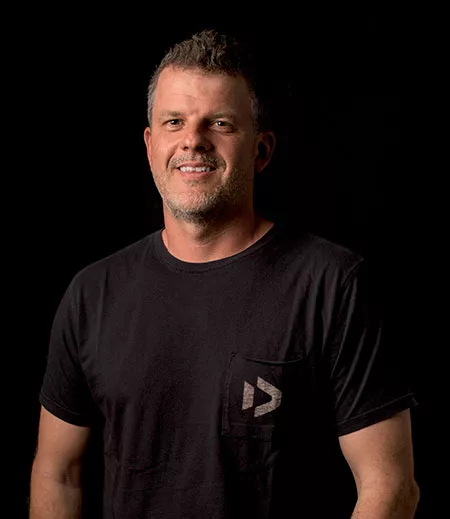
“Thomas Kaiser is Marketing Director at Duotone / Boards & More GmbH and is one of the formative minds behind the brand development of one of the world’s leading water sports companies. He has been part of the organization for over a decade and has been instrumental in shaping the transformation from North Kiteboarding to today’s Duotone brand. With his experience in international brand management, product communication and strategic marketing, he is now responsible for the global positioning of Duotone across multiple disciplines – from kitesurfing to wingfoiling and stand up paddling. “
This is roughly how ChatGPT describes the strategist behind the Duotone brand and we at Stand Up Magazin are very interested to hear from him. Anyone who knows Stand Up Magazine knows that we are not only interested in water sports itself, but also in the industry in which we operate.
With this in mind, thank you Thomas for taking the time for Stand Up Magazine and thank you for working with us. Before we talk about the business, tell us something about yourself. How did you get into water sports?
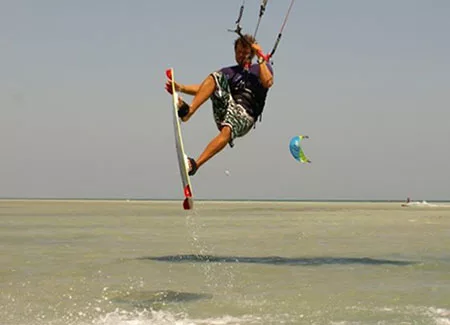
I first came into contact with water sports in 1998 – at Mondsee, on one of the very first kitesurfing courses ever. That was a time when kitesurfing was still completely new territory. Hardy Brandstötter, one of the pioneers of the sport in Austria, had just started to set up one of the first training structures there.
There were hardly any schools, hardly any material – but an incredible sense of optimism. I was immediately gripped by this feeling. I got my kite instructor’s license in 2002 – and the sport has never let go of me since.
What motivates me to this day is that feeling on the water: being completely in the moment, feeling the wind, water and nature intensely. I live on Lake Neusiedl and am regularly on the water there – kitesurfing is still the core for me, but SUP has become an important balance. It’s calmer, slower – but in the end it’s always about the same thing: being outside, exercise, nature and that feeling of freedom.
You’ve obviously had a good career in water sports and have certainly gone through many cycles. But let’s start with the current status: In March, DUTONE expanded its product range to include inflatable SUPs. We at Stand Up Magazine see this as a very positive signal to the industry. In a post-Covid world, board sports have only gone downhill. Many stores have closed in Germany, boot is complaining about a loss of exhibitors and Boards and More has also withdrawn from the SUP race sector with Fanatic, to name just a few examples. Nevertheless, Boards and More is investing in the SUP sector.
Where do you see the potential for DUOTONE SUPs and why are you launching now?

The decision to integrate SUP under DUOTONE is not a short-term move, but part of a clear strategic development of our brand.
We no longer see water sports as individual disciplines, but as a coherent experience. This is precisely where SUP’s potential lies: it is the easiest way to enter the world of water sports – an “easy entry” that appeals to an incredible number of people.
Why now? Because the market has regrouped after the Covid phase. The hype is over, but that also means that a stable, relevant core remains. And it is precisely in this phase that the most sustainable brand positions are created.
Our customers are deliberately broadly conceived:
- Beginners who are getting into the water for the first time with SUP
- Recreational users who see SUP as a balance to everyday life
- Core water sports enthusiasts looking for extra time on the water
- Families and communities for whom SUP is a unifying element
SUP is not just a product segment for us – it is a strategic access point to the entire DUOTONE universe.
The SUP sport is still very small and yet, key events throughout Europe are enjoying good attendance. The International Canoe Federation was also able to attract more than 300 people to Abu Dhabi last year. How do you observe the active SUP sport?
The active SUP sport is small but stable. Events work, the community is committed and very loyal. The important thing for us is that we don’t evaluate SUP primarily in terms of competition. The real strength lies in access, breadth and the lifestyle aspect. The sport doesn’t just thrive on events, but on its role as a connecting element within water sports as a whole.
If we look at the demographics of the active sport, we see that the sport is dominated by over 40s and over 50s. Wingsports also seems to have a resurgence of old windsurfers/kiters. How do you see this from the Duotone Global perspective?
We see this very similarly globally. Many disciplines in water sports are currently strongly influenced by a target group that has been in the system for a long time – often former windsurfers or kiters who are finding their way back onto the water via wing or other new disciplines.
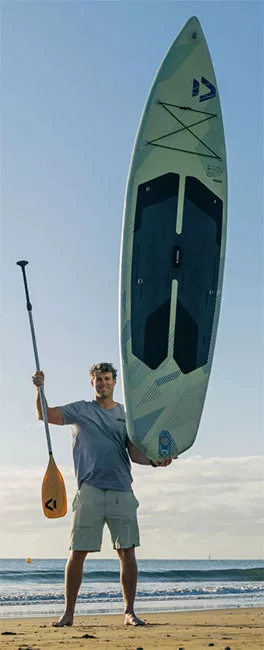
This is an exciting effect because it shows how closely the different types of sport are connected. People don’t just switch out of sport, they move on within an entire ecosystem.
At the same time, we see that the target group as a whole is growing – both individually and across generations. Many remain active for much longer and are increasingly passing on their enthusiasm.
Ultimately, it is not just about retaining existing target groups, but also about opening up the sport in the long term and developing it further.
Will young ones follow and if so, where do you see them coming from?
Yes, they are coming – but differently than before.
SUP or wing are often the first points of contact. A new generation is growing up – no longer primarily through clubs or traditional competition structures, but through experiences, travel, digital inspiration and communities.
The approach today is much more emotional and visual. It’s less about performance in the first step and more about experiencing the sport in the first place and discovering it for yourself.
This is precisely why it is crucial to actively invest in young talent. Through Young Blood Camps, targeted youth programs and support, we can create new approaches and get kids back on the water – away from purely digital consumption and towards real experiences in nature.
In the end, growth occurs where we manage to trigger enthusiasm and anchor it in the long term.
Speaking of demographics: I recently read an interview in Foiling Magazine with the American Sensi Graves from the AWSI. (Association of Windsports Industry). Her thesis was as follows:
“However, while brands in the wider wind and watersports industry initially saw growth – through the production and sale of wings, SUP boards and parawings – many of these customers were not new entrants, but existing segments within windsports. Kiters became wingers, windsurfers started SUP foiling, and wingers switched to parawing. In fact, we haven’t really grown, but have redistributed the same customers within the market over and over again.“
(Editor’s note: We had an interview with Sensi Graves pending, but never received an answer)
What are your thoughts on this?
The observation is not wrong – in the short term we are definitely seeing a lot of movement within existing target groups. Kiters are moving into wingsurfing, windsurfers into foiling and many are trying out new disciplines.
But from our point of view, this view falls short.
If you look at individual sports in isolation, it looks like a redistribution. If you look at water sports as a system as a whole, something else happens: people stay in the sport longer, expand their range and spend more time on the water overall.
This is where the real growth lies.
New disciplines lower barriers to entry, create new approaches and make the sport more versatile. SUP, for example, brings completely new target groups to the water – often people who previously had no connection to traditional wind sports.
At the same time, it is our task as a brand to consciously shape and develop these entry points. Through products, but also through programs, communities and experiences.
Ultimately, it’s not just about attracting new customers, but about creating a system in which people remain part of the sport in the long term and continue to develop within it.
Let’s talk briefly about the latest trend: we are entering the third summer of parawing in 2026. Opinions on the future of parawing still seem divided. Many here on Maui compare the parawing phase to the early years of kiting: not mature enough some say. Still others find it too difficult.
Where do you see the potential for sport as such and the commercial opportunities and risks?
Parawing is currently in exactly the phase in which many new disciplines start – very early, not yet fully developed, but with clearly recognizable potential.
In my opinion, the comparison with the early kite years fits well. In the beginning, access is often more demanding, the products are still developing rapidly and the target group is initially rather narrow.
At the same time, this is precisely where the opportunity lies: parawing opens up new usage scenarios and expands existing disciplines. This can be extremely exciting for experienced water sports enthusiasts because it creates new possibilities on the water.
The sport is still in its infancy and offers great potential for development – both in terms of technology and access for users.
Commercially, it is important to be realistic about this. Not every new discipline immediately becomes a mass market. It takes time to optimize products, lower barriers to entry and reach a broader target group.
The risk lies in expecting too much too soon or trying to scale the market too quickly.
The opportunity lies in being part of the development at an early stage, building up expertise and actively helping to shape the sport.
Ultimately, it’s about allowing innovation to happen without being driven by short-term hype – but with a clear view of the long-term potential.
Thank you very much for your comments, I am also very excited to see how it all continues and thank you again for your cooperation.
It is a pleasure.
Interviews like these come about because there are brands that support our work. We live from the support of the industry and our readers. Become a supporter of our work.

Online Subscription
Are you enjoying the content of the Stand Up Magazin?
With a subscription, you help secure the future of Stand Up Magazin.
Become a patron and supporter with your subscription.
Your subscription is an annual contribution and renews automatically.