
It’s incredibly exciting to see how the international SUP community came together in Italy and how Germany is making its mark on the international stage. Even though we haven’t really had any elite athletes since Sonni Hönscheid, it’s still very impressive how Manuel Lauble won three gold medals in the 40+ age group. Something that, before him, only Peter Weidert had managed to do.
Addendum and Correction: (October 22, 2026) We should have noted this after Sarasota. It was actually Susanne Lier who won all three gold medals in the 40+ class in Ungran in 2021. Credit where credit is due. Over the past five years, the masters classes have become much more prominent. With that in mind, we apologize to Susanne for forgetting her. In that case, we must note that this top performance at the ICF World Championships was achieved exclusively by German athletes.
There were also major successes to report in the junior division. Marlon Daskiran won two silver medals, and Benyam Bossack took silver in the long-distance race. In the women’s sprint, Skadi Langbein advanced to the A final.
It was really great to see all of that. Unfortunately, we at Stand Up Magazine couldn’t be there for reasons you know, but we do have a great interview with Manuel Lauble to share.
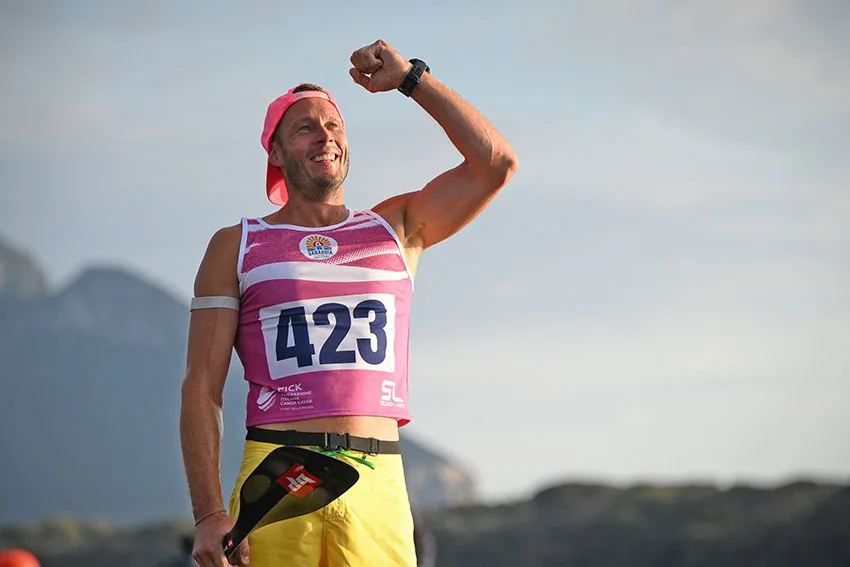
First of all, congratulations on your three gold medals. How cool is that?!?! No one but Peter has ever done that. We just have to ask you a few questions and tell the story so it goes down in German SUP history.
What an incredible year for you. You won three gold medals at the ICF / Paddle Worldwide World Championships. So before we get into the details, why don’t you tell us briefly what the World Championships were like?
Thank you very much, Mike. Yes, that was the perfect finale. A truly great World Championship in Italy—the biggest one ever, with over 900 athletes from 58 nations. It was a huge celebration with sunshine and a fantastic atmosphere. The many volunteers really went out of their way to ensure everything ran smoothly. I was pleased to see that the schedule was followed 100 percent. Every athlete knew exactly when their race would start and what time they had to get on the water. As far as I can tell, there was also a great livestream (unfortunately behind a paywall). At times, there were three drones in the air, supported by stationary cameras on the shore, in the finish tower, and on boats. Spectators and athletes alike were able to watch the spectacle live on a large LED wall, with commentary by Mister TotalSUP. The screen also displayed rankings and live data such as distance to the finish line and current speed.
Wow, that was really awesome—too bad we couldn’t be there. It was apparently the biggest SUP party the world has ever seen. But now let’s talk about the individual disciplines. In the sprint, you actually crossed the finish line at exactly the same time as the Argentine. What was that like? Were there any disputes?
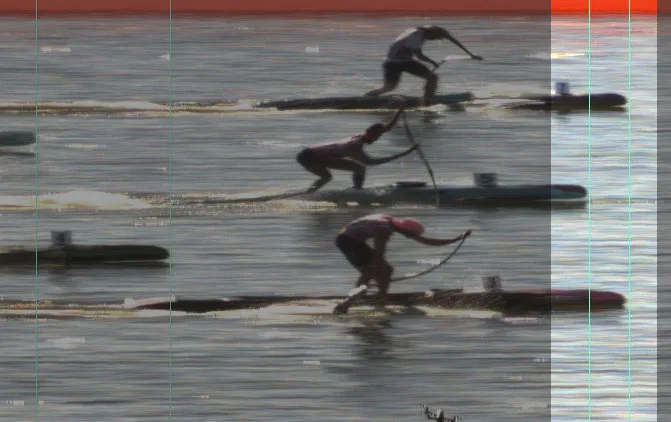
It was an incredibly close finish. As we crossed the finish line, we didn’t know who was in the lead. It took quite a while for the photo finish results to be analyzed. We were already paddling toward the dock when the news came from the finish tower. Lucas Correa and I had exactly the same time, down to the hundredth of a second (25.80). Close behind was Ryohei Yoshida (25.90), who crossed the finish line just ten hundredths of a second behind us. We were overjoyed. The photo finish speaks for itself. There’s nothing to debate here -> see photo finish
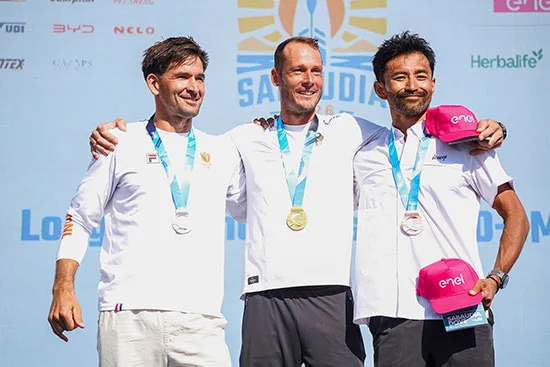
In the Tech Race, you were actually 4 seconds faster than your Japanese competitors. Can you tell us a little bit about that?
The final promised plenty of action—packed with the fastest racers in our class: Lucas Correa (ARG), Ryohei Yoshida (JPN), Hermann Husslein (THA), Francisco Giusti (ARG), the reigning world champion, Viktor Kraus (GER), Szabolcs Fodor (HUN), and Takahiro Kashiwabara (JPN). After a fast start, Ryohei and I reached the first buoy after a good 100 m. Behind us, things really heated up. We were able to open up a small gap. For the next 600 meters, I stayed in the draft and used the side waves to conserve energy. At the last buoy, about 80 meters before the finish line, I launched my attack to take first place.
How did the long-distance race go? You were faster than Joep van Bakel. But it took a little while before Ryohei and Teichi caught up. What was the course like, and what was your race strategy?
I knew that this year’s long-distance race would be very tactical. All the paddlers knew what had happened in Abu Dhabi, when I paddled away alone in the lead and ultimately crossed the finish line with a lead of over 2 minutes. Even at the starting line, we had our eyes on the competition. The course was L-shaped and consisted of three laps.
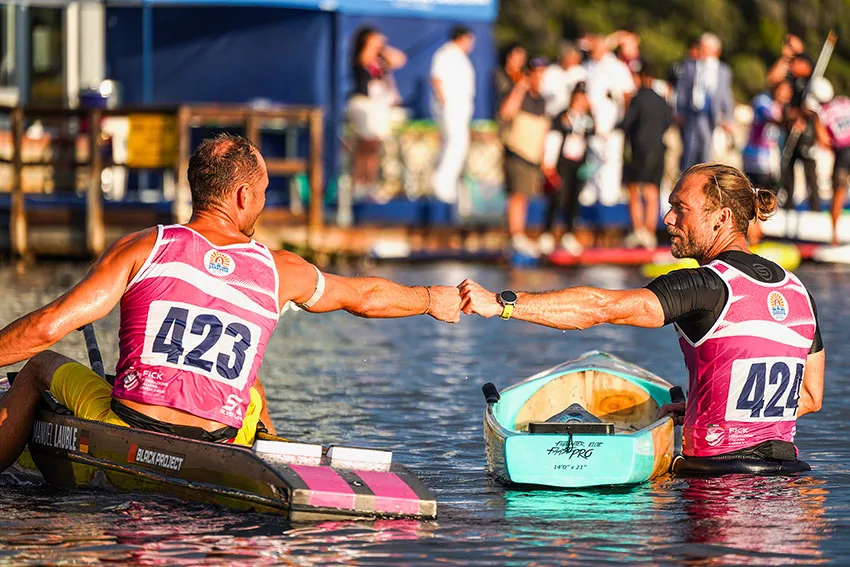
The long straight stretch to the first buoy (1,400 m) ran exactly in the direction of the wind—upwind on the way out and downwind on the way back. Joep, Ryohei, and I were able to quickly break away from the pack. I knew it would come down to a sprint to the finish. After a failed attack by Joep on the final lap, I significantly increased my pace and opened up a gap. I went all out for the last kilometer and secured the victory in the long-distance race.
Wow, that’s really cool. Tell me, how did you manage your training as a dad and while running a business? How much time did you put into it? Was your family in Italy, too?
I was really happy that my wife was able to come with me to Italy. Unfortunately, our two children (15 and 18) weren’t on school break, so they stayed home. My day is well-structured. I usually do my first training session during my lunch break or in the afternoon (in which case I skip lunch), followed by a second training session in the evening. I train 12–14 times a week. Usually, I’m on the water every day, combined with strength training at the gym and light running sessions focused on building a base. Our two kids are already grown up, which of course makes things much easier. And in general, training is a great way for me to unwind and clear my head. I enjoy pushing myself and constantly strive to improve. My coach, Christian Taucher from SUP.Training, tailors my training plan and performance analysis specifically to me and my competition schedule.
I noticed that many countries had a strong team spirit—how was that for Team Germany? Did you guys organize yourselves? It was kind of hard to tell from a distance. If you did organize it, who was in charge? DKV or GSUPA?
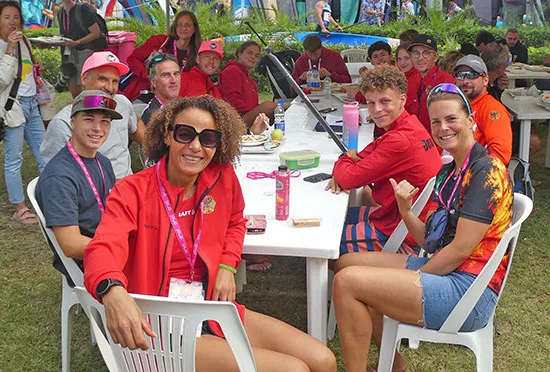
With 52 athletes, Germany had its largest delegation ever at a World Championship. Only Italy, Spain, and Greece had more participants. With such a large venue and the different start times for the Junior, Open, Masters, and Women’s/Men’s divisions, the athletes naturally ended up spread out a bit.
But we kept running into each other, whether by chance or by arrangement—at lunch, in front of the big video screen, or at the opening ceremony. Thomas Hanke-Hanel (Head of the SUP Division) and Peter Weidert represented the DKV on site and supported us.
One more thing about the juniors—we saw Marlon and Benyam on the podium. It looks like the German juniors are on the rise?
That’s so cool! I’m really happy that our young athletes are performing so well. Marlon (silver in the juniors) has made incredible progress and is now the third-fastest sprinter on the planet. With his time of 23.96, he was even faster than seven of the eight finalists in the open class (I know you can’t really compare different races, but the numbers are still impressive). That’s crazy! Benyam dominates in the technical events and on the long-distance courses. Skadi put in an incredible performance. And with Andri, Oscar, Anton, and others, we have even more strong young paddlers. I wish we’d invest even more in supporting young talent here in Germany.
Thank you so much, Manuel. That was a truly amazing performance, and it’s great to see you representing Germany on the world stage.
Do you think it’s great that Stand Up Magazine is the only publication in Germany dedicated to the sport of SUP? If so, please become a supporting member of our community—and who knows, maybe one day we’ll be back at the SUP World Championships.

Online Subscription
Are you enjoying the content of the Stand Up Magazin?
With a subscription, you help secure the future of Stand Up Magazin.
Become a patron and supporter with your subscription.
Your subscription is an annual contribution and renews automatically.