
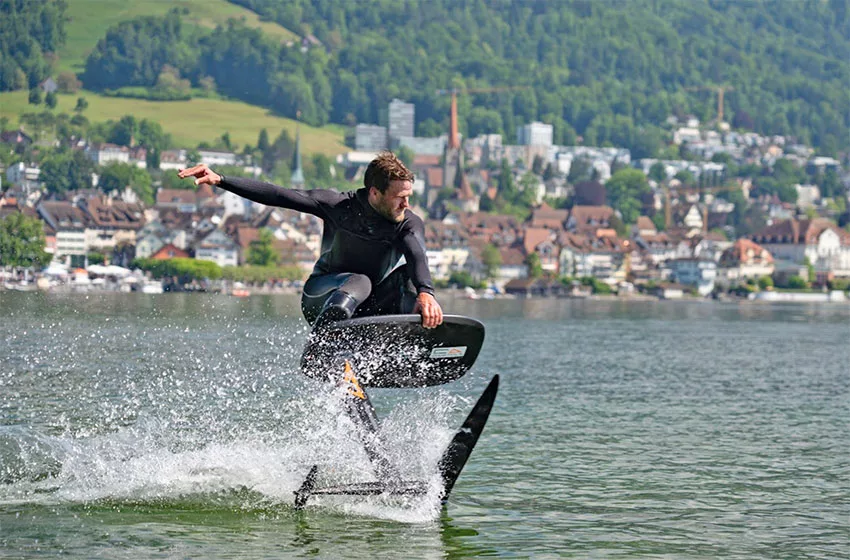
Tim Michaelis is 34 years old, married and lives in Zug, Switzerland. He originally comes from North Hesse (Germany), where he studied mechanical engineering. He moved to Switzerland around eight years ago.
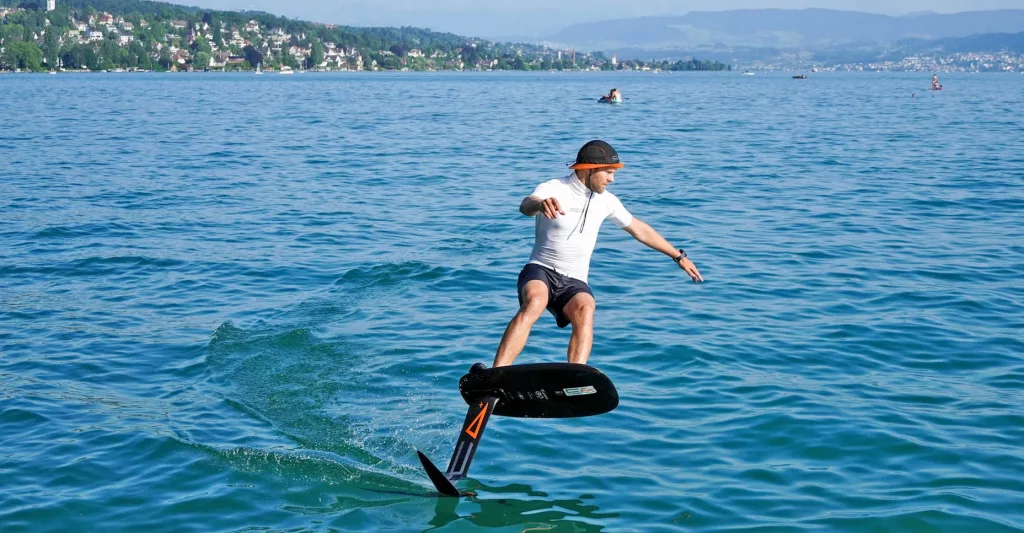
Tim’s first contact with pump foiling was more of a coincidence: a work colleague took him to a session in Zurich – and on his very first attempt, he managed to pump the Limmat to the other side. The enthusiasm was immediate. In August 2023, this fascination deepened at Lake Constance, where he rented a pump foil set-up and spent a whole day on the water.
This changed when he moved to Zug a year later. Tim originally wanted to start wingfoiling and bought second-hand equipment – but a wing was also suitable for pumpfoiling. With the addition of a pump board, he rediscovered the sport. It soon became clear that Lake Zug only offers ideal wing conditions on a few days a year. Instead, Tim stuck completely to pump-oiling.
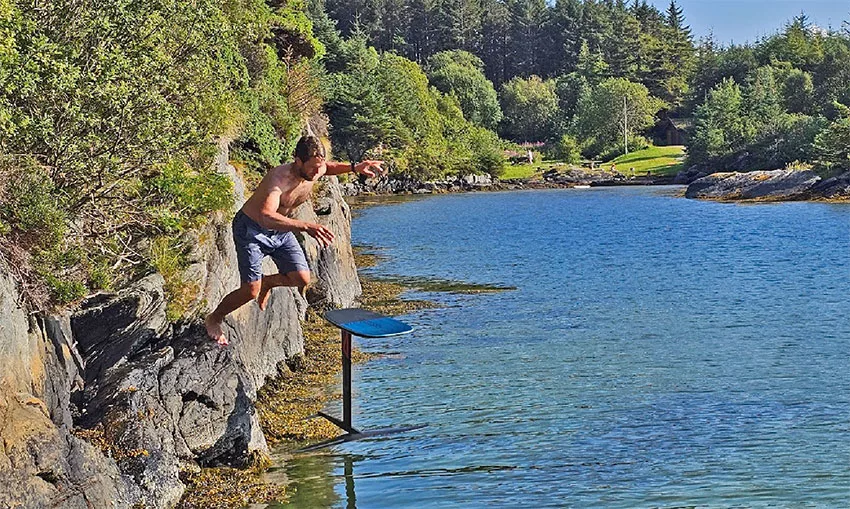
Today, pump foiling is the perfect sport for him: the strong community in Zug, the short distances to the lake, the opportunity to get out on the water after work and the athletic mix of balance, precision, body control, endurance and speed make every session special. After stressful days, pump foiling also serves as an ideal mental balance for Tim. He also appreciates the sport’s comparatively high level of safety – especially after previous injuries while mountain biking and paragliding.
His journey with Code Foils began at the end of 2024 when community member and Code Foils dealer Andy Meienberg showed him the 1540S. Tim was immediately convinced and bought the Foil outright. When the Code Foils team visited Zug in 2025 and saw him riding, he was invited to become part of the team – an offer Tim accepted without hesitation. His main discipline is pump foiling, preferably freestyle.
He currently loves riding the 1725S, which he particularly appreciates for jumps. For wake and deep water sessions, he prefers the R series, usually the 960R, which he loves for its efficiency during long pumping sessions.
We were interested and spontaneously asked him for an interview:
Aloha Tim, thank you very much for your time. We read in the intro that you have already been pump foiling on various lakes in Switzerland. Tell us what it was like in the first few days of foiling.
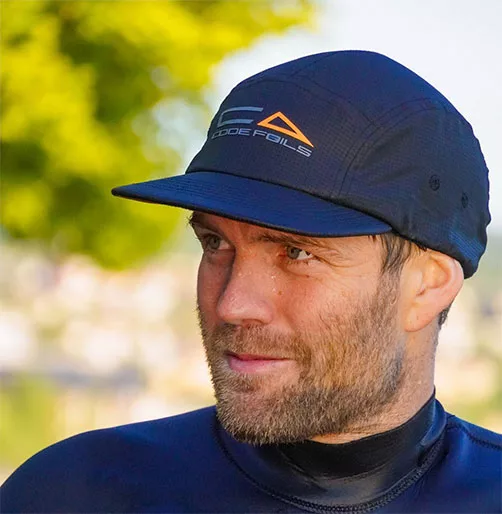
I had my first session with a colleague. He showed me roughly how it all works and just let me jump on. I spent the sessions after that alone – not because I wanted to be alone, but because I didn’t know any foilers in Zug yet. I made progress in that time, fell into the water a lot and had a lot of fun.
Things really took off when I got to know the first people in the Zug community and we arranged to go foiling together. It’s often small tips that make a huge difference. I was immediately made very welcome in the community.
So you live in Zug by the lake, which is a dream if you can live so close to the water. You talk about a unique community there. Could you tell us something about the Zug pump community?
Yes, our community is unique in my opinion. It’s always so much fun with everyone, we push each other, give each other tips and laugh a lot together. I think a community like this is important, it motivates you to go a long way. For me, foiling is not just about the sport, but also about meeting my colleagues. If I don’t have time to pump, I often go to the lake just to have a quick chat with the others.
It’s hard to say how many of us there are, as there are some who you see three times a year and some who are there very often. Of the regulars, I’d say there are about 20 of us. As with most communities, we are male-heavy, but about 1/5 are women.
The nice thing is that you can really see the level rising. You can see that everyone is making great progress.
Interestingly, I’m one of the youngest in our community, but everyone is young at heart.
Another topic: We can see from your pictures how talented you are and everyone is pushing the limits enormously at the moment. How do you see the evolution of pump foiling?
Pump foiling is still very young in Switzerland. The first pump foilers – maybe 6 years ago – simply tried to make it work somehow (according to the stories of the pioneers). In the meantime, the material has become much more efficient and there is much more information on how it works – be it countless videos or people from the community who give you tips.
I think the answer to where the journey is going is twofold.
On the one hand, the material is developing at an enormous speed at the moment. In my opinion, the supreme discipline is foils that have an excellent low and high end, are maneuverable and can be pumped over very long distances at the same time. In other words, the egg-laying wool-milk sow. I think that over the next few years we will see better and better foils on the market that come closer and closer to the ideal.
On the other hand, there will be more and more talented riders who will push the boundaries of what is possible further and further. I currently see four main types of pump riders: long distance, sprint, freestyle and wakethieves. Whether there will be more in the future remains to be seen.
What are the tricks that were popular last summer and that everyone had to learn?
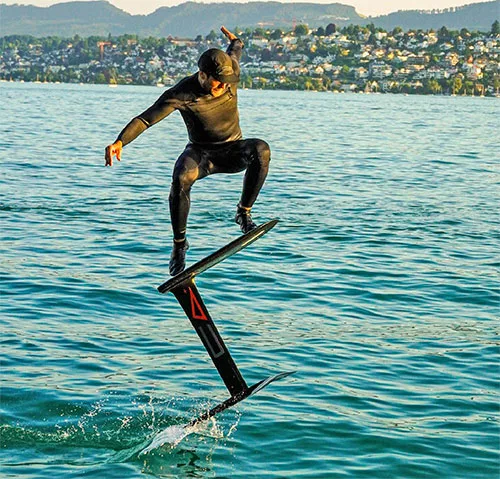
A lot of people are interested in jumping. Many of us have also started riding switch and have made considerable progress. And of course, fat turns with the wing as far out of the water as possible are the order of the day – and probably always will be.
The equipment is of course also very important for high-performance maneuvers. We gathered from the intro that you are very happy with the foils from Code. Can you tell us and the readers a bit more about your set-up?
I ride different setups depending on what I have planned for the day. As I prefer to freestyle, I currently ride the 1725S, the XS Fuse, the 110R Tail and the 75+ mast.
In my opinion, the Foil is currently the best for jumping – even jumps without fuselage and tail are possible with it.
Of course, it’s not the fastest or most maneuverable foil, but you can really lift the wing out of the water during turns.
The enormous glide makes some tricks easier, as you have more time to perform them or can simply hold them for longer.
I usually use the 960R with S Fuse and 120R Tail for wakethieving – it’s a fast setup that allows you to cover even longer distances. It’s winter here at the moment, so there aren’t many boats out and about, but I’ll be using it again in the summer.
If you really want to ride long distances, the 1250R is of course more suitable.
For newcomers in particular, it’s important to have a beginner-friendly set-up. What do you recommend to people who are just discovering pump foiling and are fascinated by it?
Before you buy any material, you should get a teacher or colleague to show you the ropes.
It may be that you realize relatively quickly that the hobby doesn’t suit you. It would be a shame if you had already bought a lot of material.
What’s more, progress is usually much faster with a “coach”.
If you decide to buy, I think it’s important to choose equipment that you will enjoy for a long time. In the beginning, you need a lot of stability to enable rapid progress. But you also don’t want to have to buy a new setup every five sessions because you’ve outgrown the old one.

The R series also includes larger sizes, 960R and 1075R, which are user-friendly for beginners and allow experienced riders to foil in almost calm conditions. These wings are light and have phenomenal stiffness, ideal for fast and long rides in downwind or pumping conditions.
The interesting thing about the 1725S is that I didn’t actually buy it for myself, but as a “beginner’s wing” for colleagues who are just starting out. In combination with a long fuselage and a large tail, it is a phenomenal beginner’s wing.
As you get better, you buy smaller fuselages and tails. This way the wing can grow with you for little money. I still ride it with great pleasure.
The S-Series is available in eight sizes, each offering unique features to expand the rider’s range. It is the ultimate all-round wing, suitable for beginners and advanced riders. It is characterized by its versatility in all disciplines: Prone, Wing, SUP, Pump and Downwind Foiling.

We just had the Surf Foil Tour at the boot in Düsseldorf and saw once again how easy it is to bring pump foiling close to an audience. How do you see all the competitions: will you take part if there is one? Does the sport have a future as a competitive sport?
I think the sport definitely has a future as a competitive sport and is already showing that.
I’ve only taken part in two competitions so far. I remember both competitions very well, it’s always great to get to know other foilers and other spots.
The reason why I haven’t been to many competitions is that they are usually too far away for me. In Zug, I can be at our spot in 10 minutes by bike and can go foiling. Competitions often take 2 hours, which means that the ratio of travel time to time on the water is not always right for me. I try to maximize my time on the water and Zug is simply unbeatable.
By and large, what are your foil dreams?
I dream of the egg-laying wool-milk wing, with which you can make distance, it is still agile and fast and you can also jump with it. But since there are a few contradictions, I almost don’t believe that the perfect wing will come… But you can dream.
– A system that removes algae without causing additional drag is probably a dream for most people.
– There are now some manufacturers who rely on screwless foils – I still see potential for many manufacturers in this area. I find it a bit tedious that you have to have trained as a precision mechanic to assemble your foil.
Finally, the parawing is all the rage at the moment and is something of a halfway house between a pump foil and a wing foil. Have you ever tried it or are you completely away from foiling with wind?
I think parawings are absolutely great and see great potential there. I did a course once, but there was hardly any wind…
That’s also the reason why I ended up pumping. We don’t have much wind in Zug and I really appreciate the independence of pumping. Apart from thunderstorms, there’s practically no weather where you can’t go. If I lived on a lake with more wind, I would be an enthusiastic parawinger!
Thank you very much Tim, that was very interesting.
It was a pleasure.
Articles like these are possible thanks to the support of our industry. Stand Up Magazine lives thanks to brands like Code and readers like you. Become a supporter today.

Online Subscription
Are you enjoying the content of the Stand Up Magazin?
With a subscription, you help secure the future of Stand Up Magazin.
Become a patron and supporter with your subscription.
Your subscription is an annual contribution and renews automatically.