
SUP Surfing: Back to the roots – a conversation with Andy Wirtz from norden Surfboards
Stand Up Paddling has made an impressive journey over the past two decades. From the iconic waves of Hawaii, where SUP found its origins in surfing and later in downwind racing, the sport spilled over into the European and global inland regions. While racing and touring formats have developed rapidly, classic SUP surfing has faded into the background in many places.
The shortboard scene rejected the big boards for a long time, with many outsiders perceiving SUP primarily as an endurance and distance sport. But anyone who knows the roots knows that SUP surfing has always been something special. It opens doors to spots where no one else surfs, makes paddling to bigger waves easier and turns even tiny, inconspicuous waves into real playgrounds.

This original fascination has never disappeared – and this is where Andy Wirtz, founder of norden Surfboards, comes in. Andy is deeply rooted in the German board sports scene, knows the industry like no other and has a clear opinion on the development of SUP surfing.
We spoke to Andy about why SUP surfing might be experiencing a bit of a renaissance right now, what trends he is observing and where he thinks the scene is heading.
Our title: What happened to SUP surfing?
Aloha Andy, the world of SUP surfing enthusiasts seems to be getting smaller and smaller. As I’m formulating my questions for you, the ISA SUP Surf World Championships are taking place on the side. What began 15 to 20 years ago as an uncompromising surfing sport quickly became a boom in inland regions: “Surfing feeling on every pond” was the motto. This gave rise to SUP racing and numerous new disciplines – until even the canoeing association took an interest in the sport. We both come from board sports culture. How do you perceive the cultural shift in SUP today?
In my opinion, the SUP sport has split into two very different worlds:
On the one hand, there are recreational paddlers, mostly on iSUPs, who just want to have a relaxed ride. On the other side are racers who train professionally and have their sights set on the Olympics. SUP surfing, on the other hand, hardly takes place anymore – you only occasionally see boards in the line-up. I have the feeling that the sport has lost a lot of its original DNA, the spirit that inspired us back then.
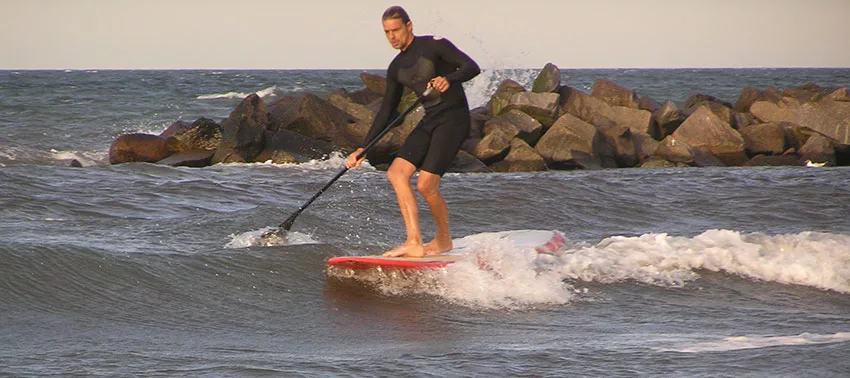
If you look at El Salvador, you can see that the ISA is trying to uphold the surf culture in SUP sport – with a good livestream and a format that is strongly oriented towards the WSL. And yet: SUP surfing hardly gets the stage it deserves. The ISA suspended SUP surfing completely last year and the APP is limited to a single event. Although SUP actually makes waves more accessible, the spark no longer seems to be ignited. Why is that?
El Salvador 2025 ISA World Championships. Luiz Diniz, 2025 Worldchamp from Brazil surfs like a shortboarder.
This is also part of the SUP sport.
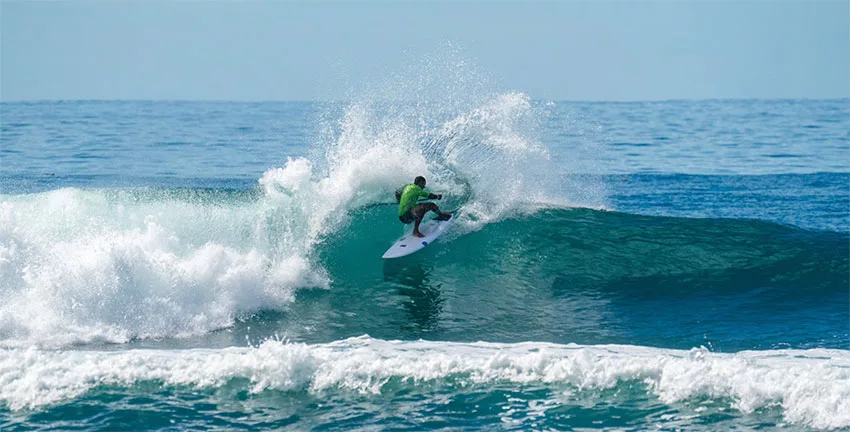
I think it’s not just down to the discipline, but also the structure of the organizations. A single event per year doesn’t bring a sport back to the big stage.
For a contest to work, you need sponsors – and they want coverage. If this cycle doesn’t come together, there will be no professional events.
Perhaps we need to think smaller again: First the contest, then the broadcast, then the sponsor. That used to work. I supported the German Wave Championships twice – for less than 1000 euros per event.
The windsurfing scene shows that things can be done differently: the PWA and WWT have long existed in parallel – one with sponsors and prize money, the other with the best conditions. Now both are working together and that is good for the sport. It would be similarly important for SUP. The scene is simply too small to be divided into several associations.
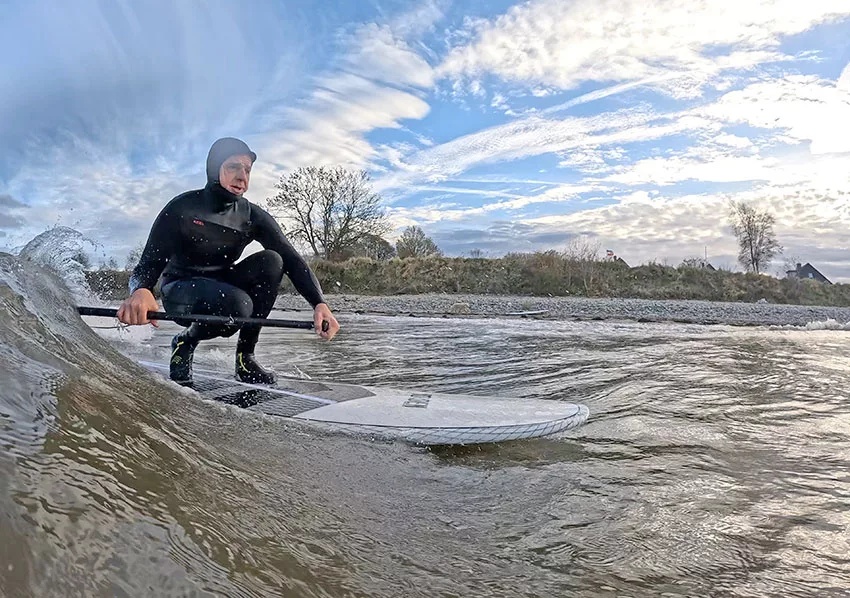
SUP surfing always works. Andy at a secret spot in Kiel – it’s called micro wave surfing, but the fun is maximum.
The Surf culture is currently experiencing a renaissance – thanks to artificial waves. And the North Sea also offers plenty of spots where you can have fun with one of your pintails almost every day. What is the SUP surf culture like in your region?
SUP surfing has clearly taken a back seat here. Many have switched to classic surfing or wingfoiling. There are still a few SUP surfers, but it’s no comparison to the past. We compete for the same community with all our fun sports – and nobody can do everything at the same time. Maybe some will come back to SUP at some point when they’ve had their fill of other toys.
In our surf crew we often say: “9’6 Pintail always works.” The board works in 80% of conditions. If I could only keep one board – that would be it. It works from knee-high to double-overhead and in calm conditions you can just go paddling with it. That’s how we got to know SUPing back then.
This year I’ve been out on the Baltic Sea more often – actually windsurfing or kitesurfing there, but when the wind was too offshore or gusty, I went SUP surfing. I’d almost forgotten how good the Baltic Sea can be – ten minutes from my office.
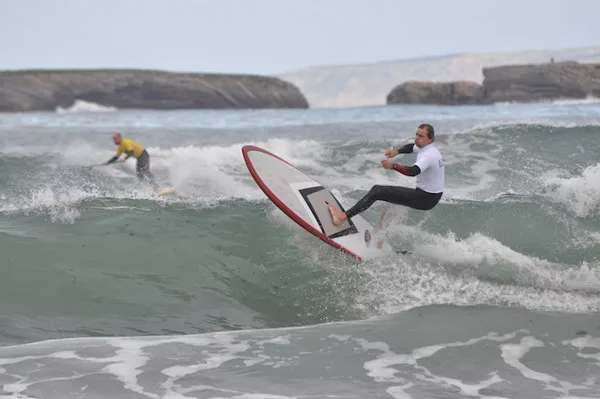
Andy Wirtz has been there since the beginning. This photo was taken at the German SUP Championships in Portugal in 2013.
You once said that you often see surfers who prefer to sit in the line-up while you “surf yourself silly” on the SUP.
Kasten Kurmis once summed it up perfectly: “When I go out on the water with friends and want to chat, I take the surfboard. If I want to surf, I take the SUP.” That’s exactly how it is.
Many people want to surf, of course – including me. But many have had more fun, more waves and faster progress on the SUP. It’s just easier.
Surfing seems decelerated, simple, cool – of course it attracts a lot of people. But I also think that the wind sports industry has not necessarily promoted the image of SUP surfing. A lot of things have been over-engineered due to the material craze. If SUP had simply been seen as another surfboard, similar to a longboard or mini-Malibu, the image would probably be cooler today.
Jens von Gersdorff has criticized the fact that SUP advertising often misses the audience because it almost exclusively shows elite racers. Are we distorting the same view when SUP surfing? 60-liter boards in ankle-deep water are not suitable for everyone.
I understand Jens very well. But it’s similar in many sports. The masses don’t drive a Formula 1 car, but the marketing still works.
A sport needs heroes, needs an extreme area to become visible. Without Laird Hamilton, Robby Naish or Kai Lenny, our SUP wouldn’t exist. It’s clear that 95% of people don’t do what they do / did.
But if we only show people paddling comfortably, the sport will die at some point. No young people will follow.
SUP is so versatile precisely because a single board covers so many areas of use – and it’s precisely this all-round board that needs to return to the stage.
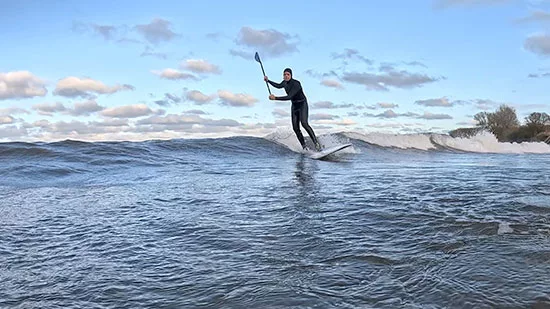
Micro Right Hander Point Break – Somewhere in the north. It’s cold, but the wave is running and Andy is having fun in the neighborhood.
What ideas do you have for getting more people back into the waves with norden? You have developed the boards for this.
We don’t have to reinvent the wheel. Everything you need to have fun in the waves has been around for a long time. At norden, we’ve always taken the middle way: don’t overwhelm, but don’t bore either.
We have to motivate people to get their boards out of the cellar again. As soon as a few start again, others automatically follow. We’ve brought some back to SUP – simply because they couldn’t stand to see us get most of the waves.
I’m currently working on a slightly revised version of our pintail longboard SUP and a new model based on our first boards. Both are real wave boards – and when there are no waves, you just go paddling.
You spend the winters in Cape Town. How is SUP surfing developing there?
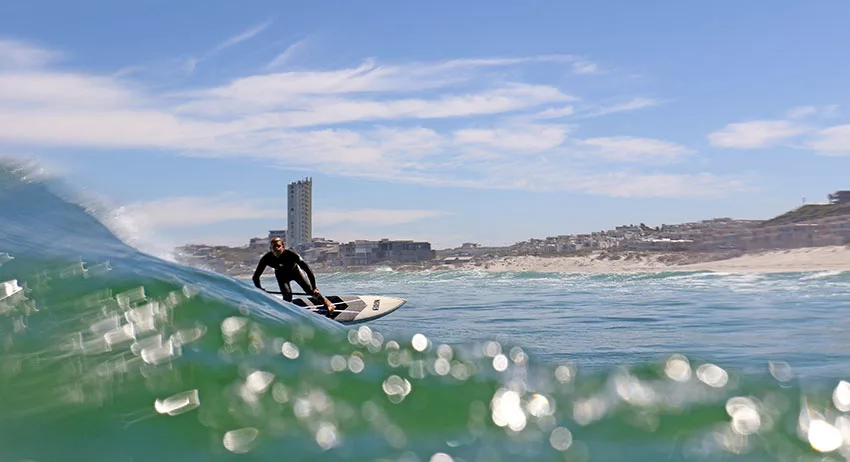
The waves of Cape Town are Andy’s second home. Many of his shapes are also tested there.
It’s basically the same picture as everywhere else: the wind sports enthusiasts from the SUP scene have switched to foil, the surfers back to the surfboard. You hardly see any SUPers on the Cape anymore. It’s not because of the conditions or the equipment – it’s because you can only do one sport at a time.
SUP still makes just as much sense as it used to, it has neither become worse nor irrelevant. The focus at the moment is simply on other disciplines – the people themselves are still the same.
Small waves and SUP have opened up many new surf spots. Now the foil brings even more options. Is the foil taking the last customers away from SUP surfing?
Foil attracts a lot of people, of course – but as I said, you can’t do everything and you can’t pay for everything. The water sports community is no longer growing, it’s just redistributing itself. This applies equally to windsurfing, kitesurfing and SUP. Foiling suits our conditions well, but is technically demanding and not suitable for everyone.
Did you watch the ISA World Championships? And wouldn’t you be a candidate to represent Germany together with Carsten Kurmis?
Of course I took a look. The level is extremely high and the performance looks really good – especially among the women. The race was also exciting, especially the run through the surf.
I would definitely have liked to have taken part in conditions like that in the past, even though I’m not a typical contest rider. If there’s another event here and the conditions are right, I might start again – but I actually prefer to surf just for fun.
Thank you for your time and your insights!
Stand Up Magazine is hoping for your subscription and support so that we can continue to go from strength to strength in 2026.

Online Subscription
Are you enjoying the content of the Stand Up Magazin?
With a subscription, you help secure the future of Stand Up Magazin.
Become a patron and supporter with your subscription.
Your subscription is an annual contribution and renews automatically.